The gondola out of Brzeće did not exist the first winter we drove up here. Back then, the way in from that side was a pair of slow two-seater chairs that didn’t even take you to the main hub, so most people skipped it and spent the extra half hour on the road to the top instead.
Now a ten-person cabin covers roughly four kilometres and more than 840 metres of vertical rise from the village up to Mali Karaman, and it turns all year, bikes included. We have come to Kopaonik most winters for about a decade. That lift is the clearest single marker of how much has changed here, and, if you look at it a certain way, how little.
The Mountain Has Not Grown, but It Does Work
The lift system has been rebuilt in pieces over fifteen years – six-seaters replacing drag lifts, high-speed quads replacing fixed-grip chairs, the Brzeće gondola as the showpiece – and uphill capacity is now quoted at something like 32,000 skiers an hour across roughly two dozen lifts. What has not changed is the terrain those lifts serve.
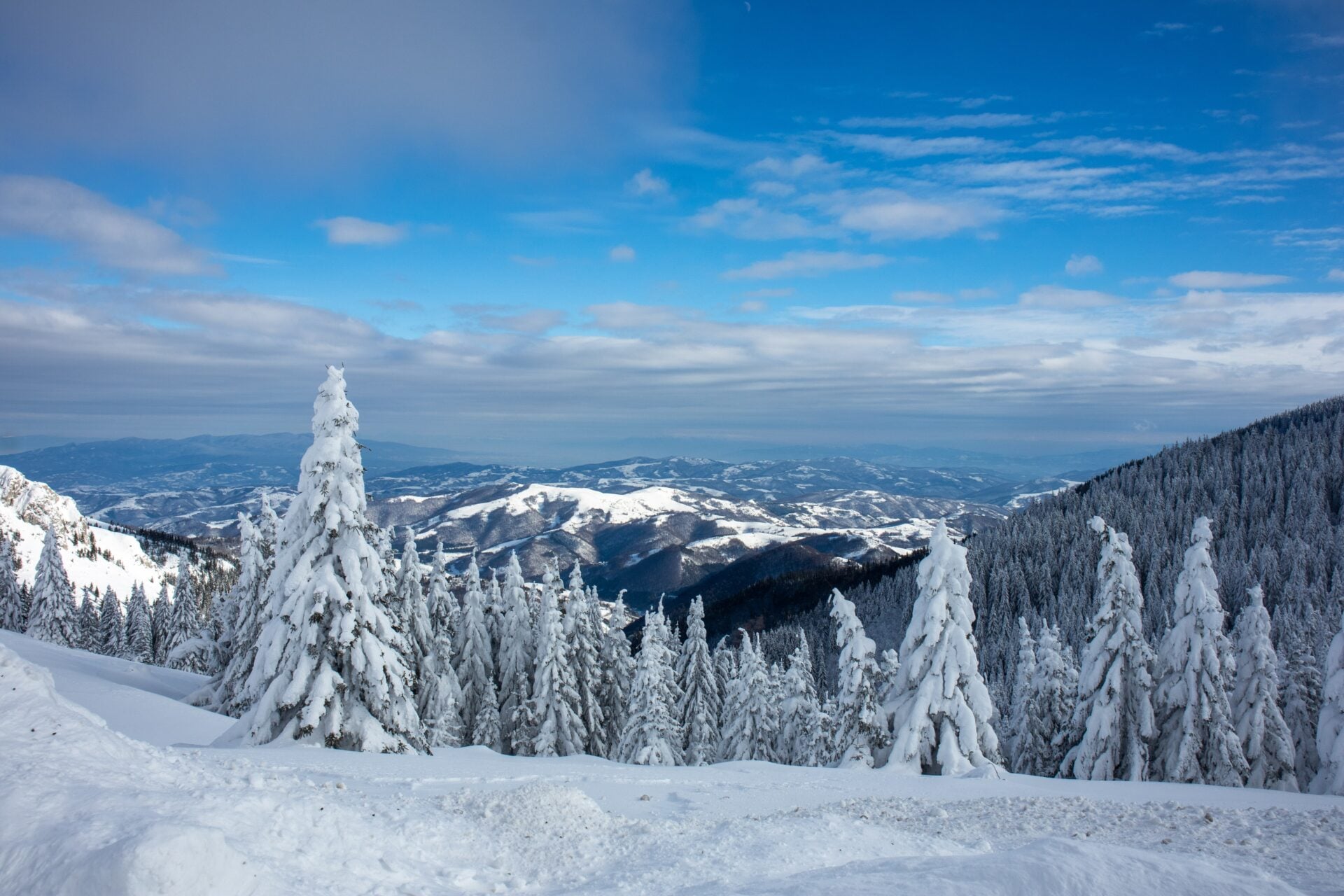
Kopaonik still has about 55 kilometres of marked alpine piste, plus another 12 or so of cross-country trail. The base of the ski area sits around 1,770 metres and the high point, Pančićev vrh, is 2,017 metres. That is a plateau with bumps on it, not an alpine wall.
Count the pistes by difficulty and it gets clearer: a little over half of the 55 kilometres is graded easy, about a third intermediate, and only around six kilometres difficult. The longest descent on the upper mountain runs about 1,400 metres of piste for roughly 250 metres of drop. The one properly long line is the gondola corridor down to Brzeće, and in a thin season its bottom half is the first thing to close.
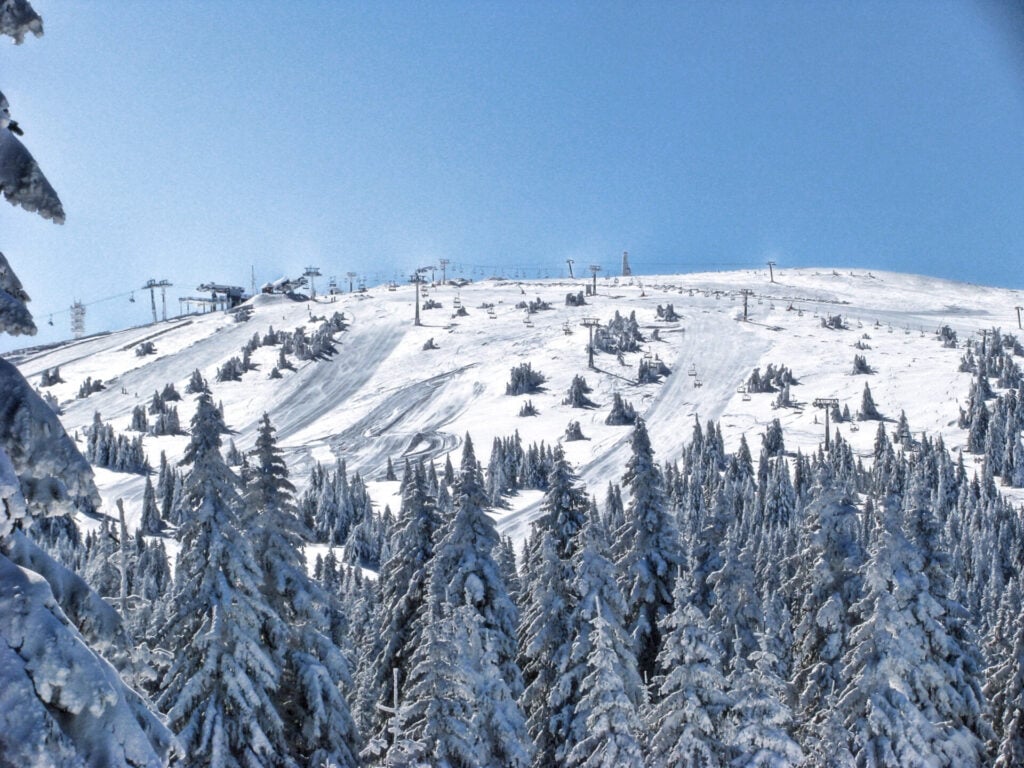
We keep coming back, so let us be fair about why. The altitude is the resort’s quiet advantage. A base at 1,770 metres in this part of Europe means the snow that falls tends to stay, and Kopaonik is usually described as holding cover for something like 160 days a year. Snowmaking is extensive and, in our experience, used early and aggressively—we have skied good, packed pistes here in mid-December when friends in bigger places were looking at grass.
The terrain sits mostly at or just below the tree line, which matters more than it sounds: on a flat-light day you can still see where you are going, and in wind the trees give you somewhere to hide. The beginner areas are the best argument for the place. There is a fenced-off learning zone with a conveyor belt and a carousel, the easy runs off Mali Karaman are wide and long enough to be useful rather than token, and the ski school absorbs enormous numbers of first-timers every week without obvious chaos. We have sent two sets of nephews here and both came home skiing.
Nearly Three Hundred Kilometres of Getting There
Then there is the journey, which has improved less than anything else. Kopaonik is about 290 kilometres from Belgrade Airport via the Kragujevac route, or closer to 300 if you go around via Požarevac and Kruševac. The motorway covers most of it and then abandons you: the last stretch is an ordinary main road with a real gradient, and the honest figure for the whole thing is three and a half to four hours in decent conditions.
We have tried most ways of getting from Belgrade Airport to Kopaonik, and none of them is quick. Scheduled buses leave from the central station in Belgrade rather than the airport terminal, which means a transfer into the city first and a timetable that does not
care when your flight lands.
On a Tuesday in late January we have never waited more than a minute for a chair. On the Saturday of the same week the queue at the main hub ran twenty minutes deep
In bad weather the last forty minutes is the whole trip. Snow on that climb has twice turned a four-hour drive into six while we sat behind lorries waiting for a plough.
Saturday Is a Different Mountain
Belgrade is close enough to be the problem. A three-and-a-half-hour drive is an easy day trip for a city of a million and a half people, and at weekends Kopaonik fills with cars that go home the same evening. The resort has two personalities as a result. On a Tuesday in late January we have never waited more than a minute for a chair. On the Saturday of the same week the queue at the main hub ran twenty minutes deep and the wide beginner pistes were unskiable for anyone trying to practise.
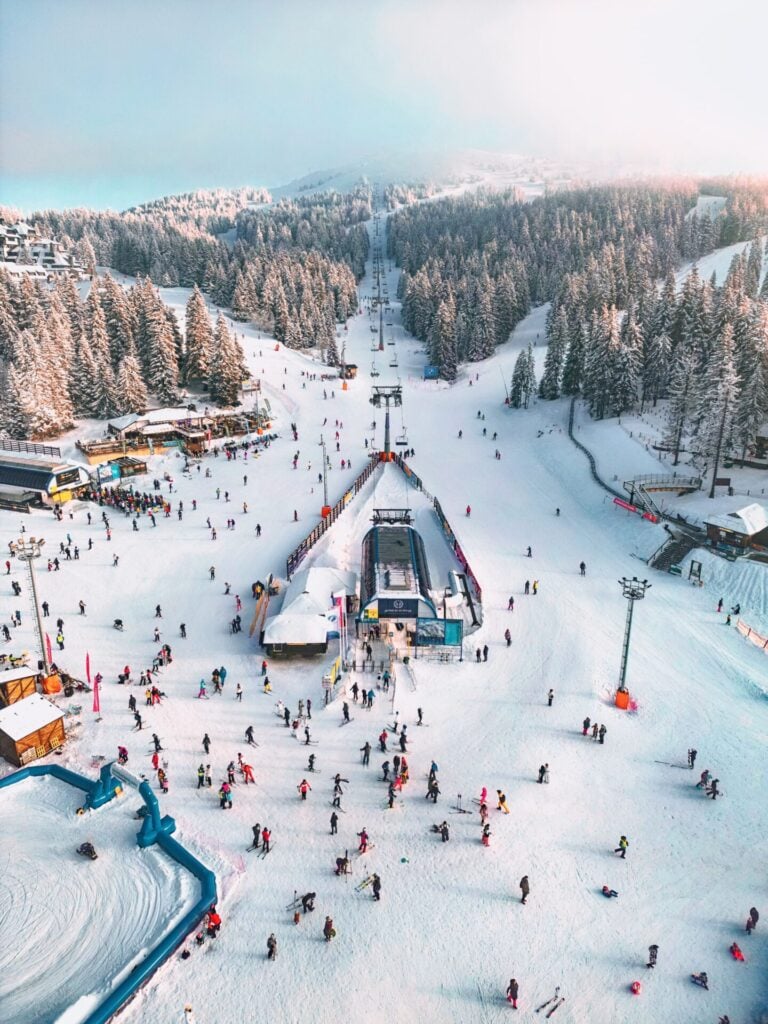
Holiday weeks compound it. Between Christmas and Orthodox Christmas, and again at the February school break, 55 kilometres of piste cannot absorb the crowd. The uphill capacity figure is real; downhill capacity is what runs out.
Prices Have Climbed Towards Alpine Territory
This is where the decade shows most. For the premium weeks Kopaonik has moved into a bracket where comparisons with Austria stop being absurd. Lift passes for the 2025/26 season sat in roughly this range, and the 2026/27 tariff is structured the same way:
| Pass | Quiet and mid periods | Peak periods |
| Adult day | about 5,600–5,900 RSD (roughly €48–50) | about 6,500 RSD (roughly €55) |
| Adult six-day | about 24,900–26,200 RSD (roughly €210–225) | about 27,100 RSD (roughly €230) |
| Child day | about 4,400 RSD (roughly €37) | about 5,000 RSD (roughly €43) |
Two six-day adult passes at roughly €440 is still clearly less than a mid-sized Austrian resort, and the pass is not the thing that has got expensive. Accommodation is. The building boom has put a great deal of new apartment stock on the mountain, most of it let short-term, and rather than pushing rates down it has produced a two-tier market: plenty of beds, but the good ones in the good weeks go for whatever holiday demand will bear.
Ten Years of Small Adjustments
Things we now do without discussion:
- Book late January or early March — never the New Year window or the February school break.
- Buy the pass in the online pre-sale, usually around 15 per cent off, which closes well before the season starts.
- Ski the first lift. Day trippers arrive between nine and ten; the hour before is the best skiing on the mountain.
- Stay in the centre rather than Brzeće unless the gondola is the point of the trip.
- Arrange the airport leg in advance rather than on arrival. We booked the return leg with Belgrade Chauffeur the night before and it was waiting at six in the morning.
- Pack for wind. The upper mountain is exposed and the top lifts shut more often than the forecast suggests.
Après-ski is the one thing to adjust expectations about rather than plan around. It is mostly hotel bars and a few restaurants in the central cluster, sociable in a slightly formal, indoor way, with no walk-out-of-your-boots terrace culture at all.
Questions We Get Asked
Is Kopaonik good for a complete beginner?
It is one of the better places in the region for it. More than half the piste network is graded easy, the learning area is separated from through traffic, and the ski school handles beginners in volume with English-speaking instructors. The caveat is the weekend: the gentle pistes are exactly where day trippers go.
How many days of skiing does 55 kilometres actually give you?
An intermediate skiing hard will have covered everything by the end of day two. We find four or five days the natural length. A full week works if a couple of those days are short ones, or if you are there with children.
When does the season run?
Broadly early December to early April, with the lift tariff periods running from mid-November to late March. The reliable window is January to mid-March, and December openings depend on how early the snowmaking crews get going.
Do we need a car once we are there?
No, and in deep snow it is a liability. The accommodation clusters are linked to the lifts by ski buses and much of the central area is walkable in boots. We have stopped driving up and have not missed it.
Is It Still Worth It?
For us, yes, with conditions attached. Kopaonik midweek in late January, with reliable cover and short queues, is excellent value and a genuinely enjoyable mountain. Kopaonik on the Saturday of the February holiday, at peak rates on a crowded 55 kilometres, is not. The resort has spent a decade getting better at moving people uphill and no time at all getting bigger, and the pricing now assumes nobody has noticed. Pick the week carefully and it stays one of the best-value ski weeks in Europe.