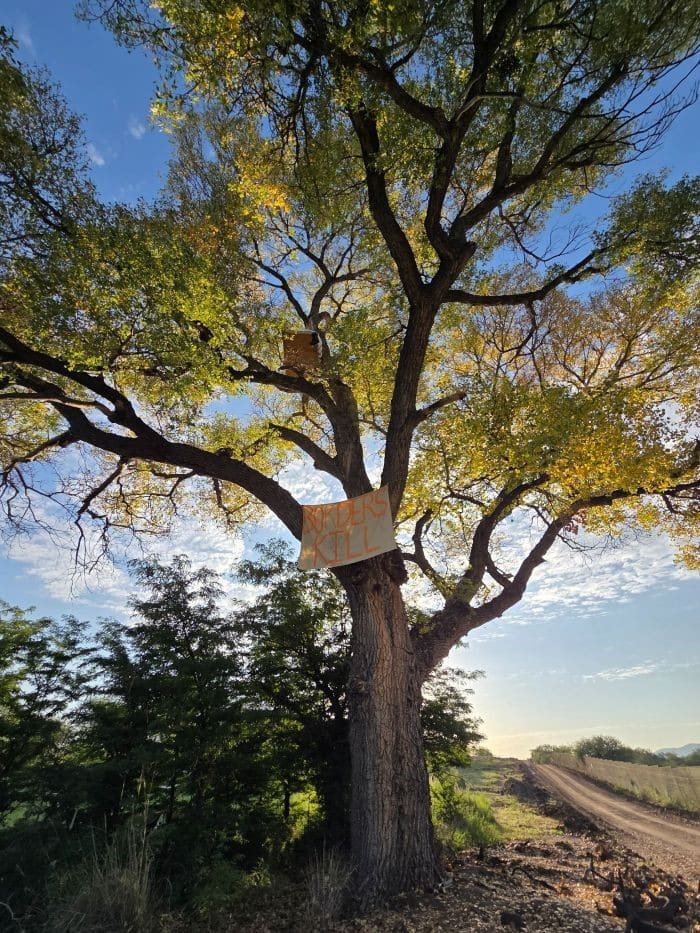
A 200-year-old tree near the US-Mexico border, known as the ‘grandmother’, has been destroyed to make way for the construction of President Donald Trump’s anti-immigration border wall.
In late July, protesters staged a vigil in the abandoned town of Lochiel, Arizona, taking turns occupying a platform high in the 200-year-old tree’s canopy for more than 70 days.
However in a dawn raid more 80 federal agents entered the camp, which is located on private land, making arrests and preventing people from reaching the cottonwood tree.
They used a steel basket on an extendable crane to remove one person from the tree platform. Others were shoved and tackled as they tried to rush toward the tree to prevent its destruction, according to witnesses.
Contractors with Fisher Sand & Gravel, a company building this section of wall, then used an excavator to push over the tree, which cracked and crashed down.
‘Seeing that – it crushes your heart,’ said Erick Meza, the environmental group Sierra Club’s Borderlands Coordinator, who has been working to save the trees for months, beginning with a series of letters to US Customs and Border Protection (CBP).
‘That tree brought a lot of people together, there’s a community response of outrage.’
At the start of their campaign the group stated: ‘For about one month now, contractors for Fisher Sand & Gravel, have heavily focused on clearing the ground for their destructive primary and secondary border wall project. They are doing this without having to comply with any cultural or environmental laws as they were all waived under provisions contained in the Real ID Act.
‘Rushing through the town with their heavy machinery right now, the contractor is destroying the cultural remains of ancient civilizations and trees that are potentially as old as this nation.’
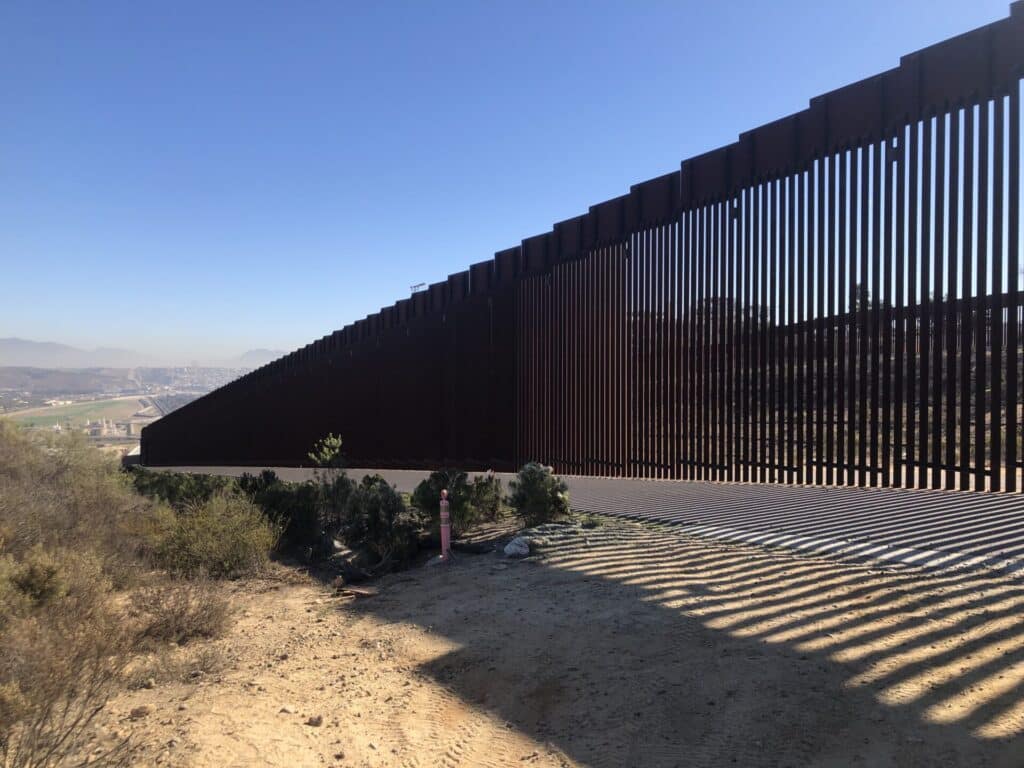
Two 10m-tall walls are being built throughout this area, known as the San Rafael valley, a remote high prairie, in order to prevent migrants getting onto US soil.
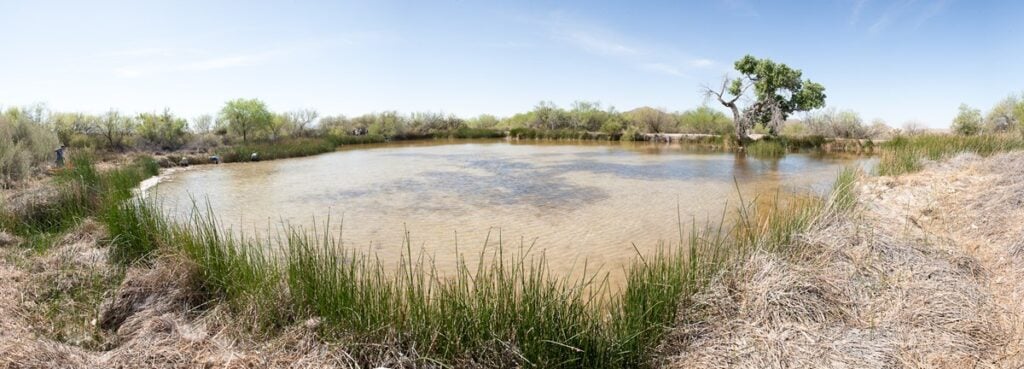
The valley, and the Patagonia and Huachuca mountains on either side of it, form one of the most important regional wildlife corridors between the US and Mexico, providing passage to animals including jaguars, ocelots, bears, beavers and porcupines.
These trees, which depend on a regular supply of water underground, are a hallmark of riparian forests, an endangered ecotype throughout Arizona and the south-west, said Russ McSpadden, an advocate with the Center for Biological Diversity.
Water use for wall construction has also depleted wells throughout the south-west, threatening natural features such as Quitobaquito Springs.