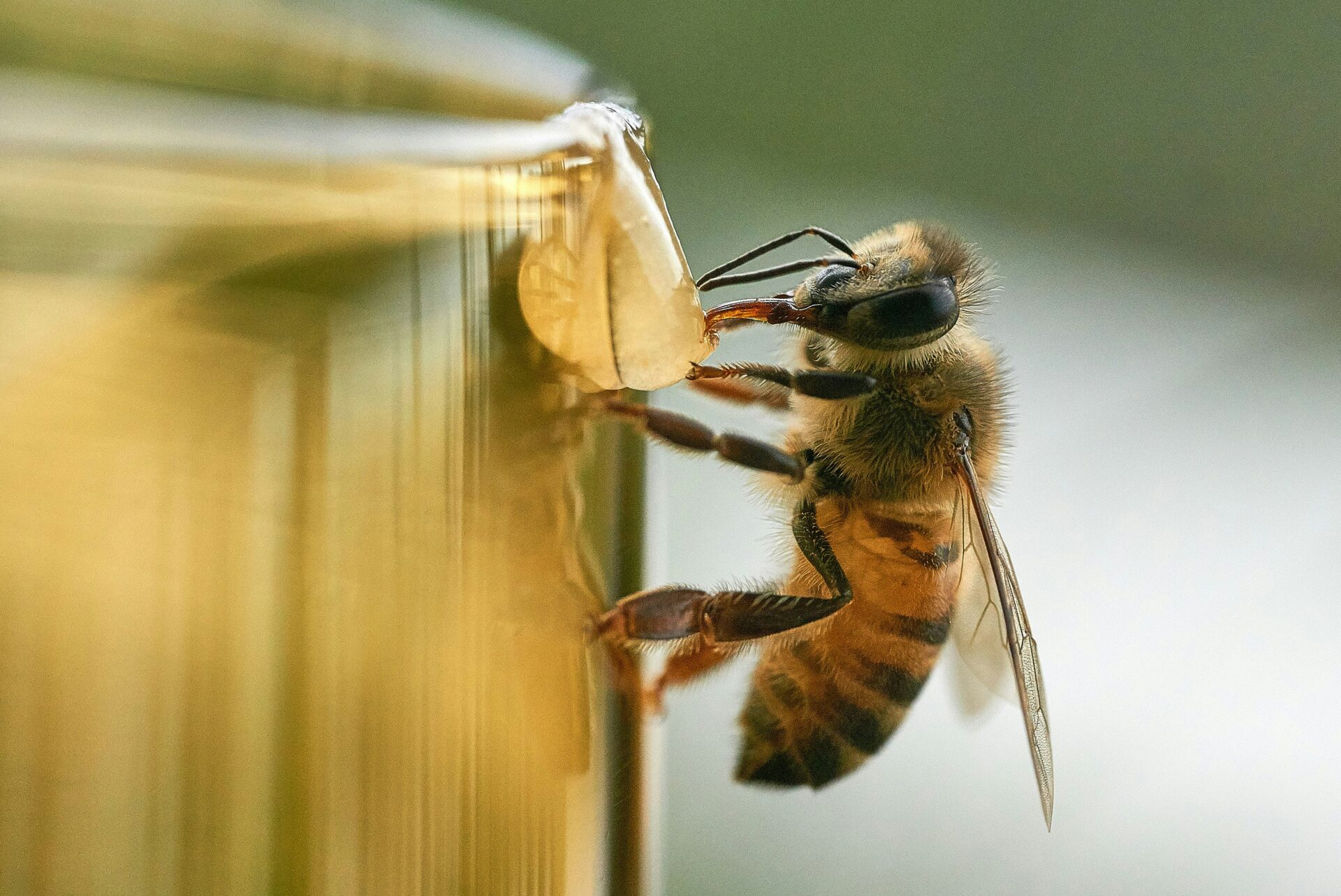
Bumblebees stick out their tongues and ‘lick their lips’ after tasting a sweet liquid, but when they taste salty or bitter drinks, they shake their heads and try to wipe their mouths.
For the first time scientists have seen an insect make a reaction to food that it ‘likes’ or ‘dislikes’ and the researchers say that it could mean bees’ inner lives are a lot more like mammals than had previously been thought.
Mammals will pull a face after tasting something they enjoy, which is seen as evidence that there is something to their lives beyond a drive to find and consume food.
Now, Professor Andrew Barron, of Macquarie University, Sydney, Australia, which jointly staged the research with China’s Southern Medical University, said the bees’ tiny facial expressions could be the key to understanding their minds.
He explained: ‘There’s always been a tension between thinking of insects as animals or some sort of mini robots.
‘Facial expressions are an important window into the internal states of animals. What we found is that bees show responses with their mouthparts to solutions that indicate their subjective like or dislike of those solutions. It tells us there is an inner life to the insect.
‘If a rat gets a salty taste it doesn’t like, it wipes its mouth parts, wipes its whiskers, wipes its tongue. And we see something similar in a bee.’
Bee Taste Test
The researchers fed bumblebees water containing either a certain concentration of sugar, from 20 per cent rising to 60 per cent, plain water, and small quantities of salt, or quinine – the chemical that makes tonic water bitter.
After taking a sip of the sweet stuff, the bees repeatedly stuck out their glossa, a tongue-like structure used to suck up liquids.
The sweeter the solution, the more often they protruded their glossa after drinking, while salt and quinine made them shake their heads.
Bees also stuck their tongues out when drinking fresh or saltwater if they had been kept in a hot environment without anything to drink.
This suggests that the behaviour isn’t just a reaction to the presence of sugar and could be a sign that they are actually enjoying the drink.
In a set of experiments, published in the journal PNAS, scientists used pharmacological techniques to investigate these mechanisms further.
They found that the tongue-sticking behaviour wasn’t linked to the dopamine-driven feeding motivation systems.
Instead, they appeared to be enhanced by a neural endocannabinoid pathway associated with emotional, or affective, evaluation in mammals.
This is a significant discovery because scientists have previously struggled to figure out what, if anything, is going on inside a bee’s head.
While their brains are simple and tiny by human standards, weighing less than a milligram, studies have shown that they are surprisingly capable.
Researchers have found they are capable of solving complex puzzles, using tools and recognising human faces.
Barron said: ‘We don’t yet understand what the bees truly experience, but we can observe emotion-like behaviours.
‘What’s important is we’ve now got a practical read on their inner life that we can work with experimentally.
‘Many people are comfortable saying that insects can sense, learn, and make decisions, but much less comfortable saying that they may evaluate things as pleasant or unpleasant.’