We lock eyes, and I freeze, villa key in hand. I’m not quite sure how to react in this situation and find myself woefully unprepared for a big cat encounter on my Safari lodge doorstep. The sleek leopard doesn’t move, doesn’t blink and nor do I as my mind races to work out an escape strategy. I’m sure shouting for help isn’t a great idea, I don’t want to startle her. After all, I was on my way to get breakfast, not become it. Then, as I realise that, for all my love of conservation, I should be able to handle this situation with more grace, she puts an end to the staring contest and pads off into the lush greenery in search of a tastier breakfast.
Ok, so that didn’t happen exactly to that affect, but, if I’d left my villa 15 minutes earlier, it very well might have.
At 6.45am, according to the team at Anantara Stanley & Livingstone Victoria Falls Hotel in Zimbabwe, a leopard was casually loitering outside my front door. I, meanwhile, was on the other side of my reserve view suite, drinking coffee on the balcony and watching impalas graze in the early morning drizzle, completely oblivious to the fact the magnificent predator we’d been searching for on safari the day before, was just metres away. Yes, in hindsight it probably was a fortuitous escape but I also couldn’t help feeling a little cheated. But such is the nature of a safari holiday.
Wilderness on the Doorstep
The day before however, had not been disappointing. I had set off with my guide and bird-watching enthusiast Hope, (who can identify and imitate almost every bird out there, which is impressive given there are 72 species of birds in the hotel’s gardens alone) in one of the hotel’s five safari vehicles to discover the 4,500-hectare reserve. We had been on the lookout for their larger inhabitants, but it wasn’t long before we were surrounded by herds of impala, which Hope affectionately calls ‘McDonald’s of the bush’, partly because they’re such an easy meal for predators and partly because of the black M-shaped mark on their bottoms.
Elephants have developed an ingenious teamwork tactic with one pushing down the fence with its foot to let the herd through, while the last in line returns the favour
A giraffe peers at me through the trees before disappearing into the vegetation, while farther along we came across zebras, kudus and yet more impalas grazing in the shade of the acacias. At one of the dams, a group of hippos was basking in the water, occasionally breaking the silence with their deep, disgruntled grunts, while an enormous crocodile slowly glided along the bank, hoping something might wander a little too close. Hope points out fresh hyena tracks and tells us about the time a pack of wild dogs entered the reserve and killed around 120 impalas in a matter of days.
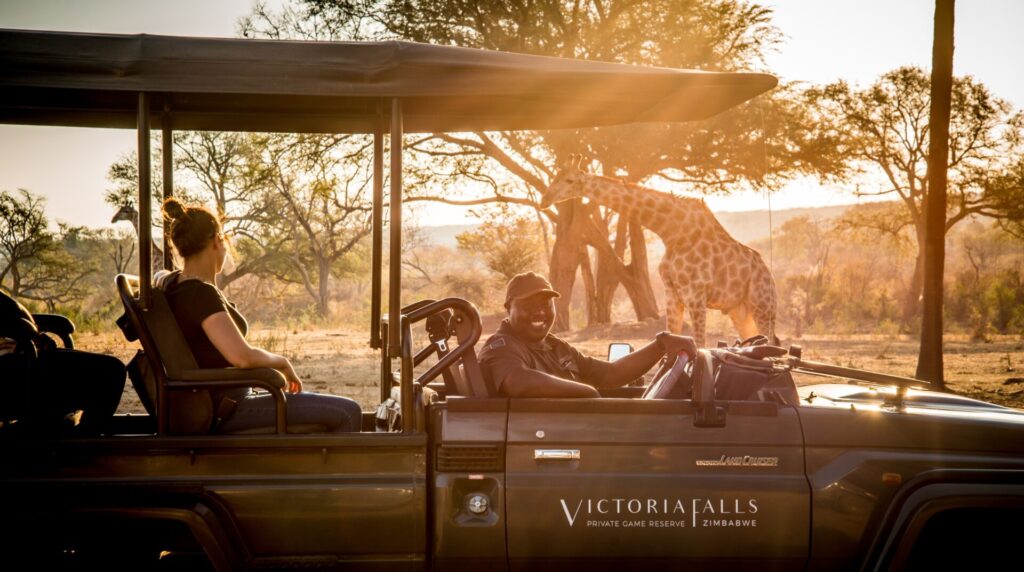
I learn that the wilderness at Anantara Stanley & Livingstone is protected by a porous boundary that allows resident rhinos and plains game to stay within the confines, while predators and elephants are free to come and go into the bordering Zambezi National Park. Leopards have worked out how to climb trees beside the fencing, while other big cats can dig under the soft Kalahari sand. Elephants, meanwhile, have developed an ingenious teamwork tactic with one pushing down the fence with its foot to let the herd through, while the last in line returns the favour. When Hope, our safari guide, tells me this story, I think it’s marvellous, although I can imagine the maintenance team probably disagrees.
The reserve has operated as an Intensive Protection Zone for black rhinos since 2006, and I learn there hasn’t been a single rhino-poaching incident here for more than a decade
Soon we come across a male black rhino feeding peacefully beside the road, totally unbothered by our presence. It’s mesmerising to watch these prehistoric-looking animals go about their business, and I listen as Hope explains Anantara Stanley & Livingstone Victoria Falls’ commitment to preserving these critically endangered animals, including dehorning to protect them from poachers. Because their horn is made of keratin, much like a human fingernail, it grows back, so it’s a process that needs to be repeated every few years. Later we encounter a female believed to be around 45 years old, which is an extraordinary age for a wild black rhino, and because of that, her horn has been left intact.
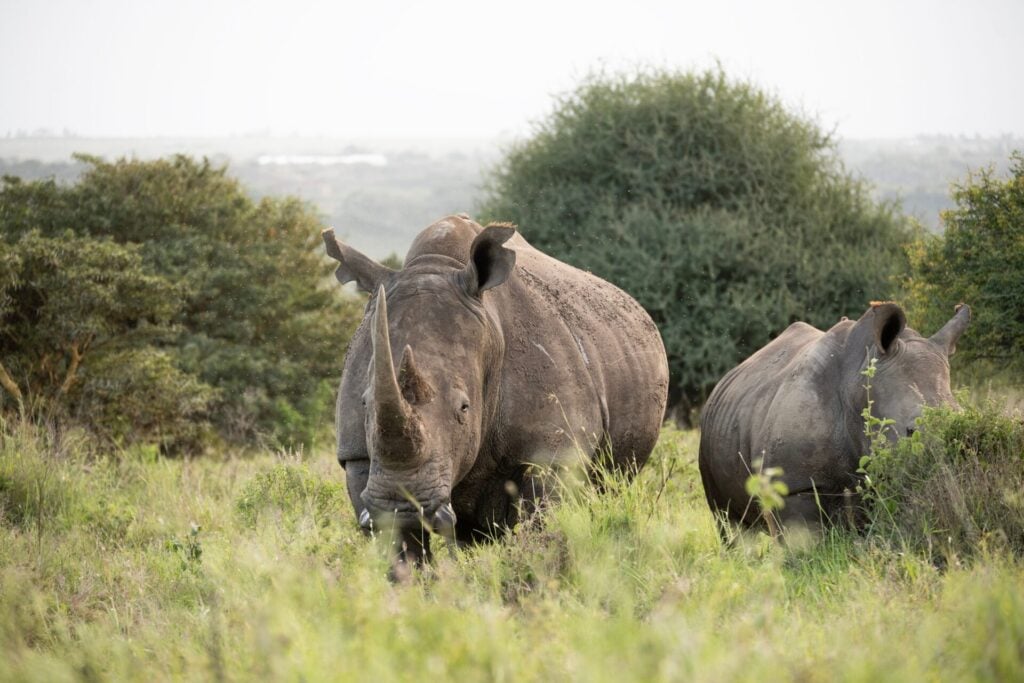
The reserve has operated as an Intensive Protection Zone for black rhinos since 2006, and I learned there hasn’t been a single rhino-poaching incident here for more than a decade. Rather than relying heavily on drones and tracking collars, the reserve employs anti-poaching teams who work around the clock, monitoring the rhinos’ movements and recording their whereabouts every day. Hope also tells me the reserve recently celebrated the arrival of its first white rhinos, joining the resident black rhinos, and that it is one of the only places in Victoria Falls to offer this opportunity.
Guests at Anantara Stanley & Livingstone can join the Rhino Guardian Game Drive, which lets them spend four hours with the reserve manager, track rhinos, and meet the anti-poaching team that keeps them safe. At US$600 per person, it’s certainly not cheap, but US$340 of that fee goes towards reserve management, helping to fund everything from fence repairs and snare removal to ranger training, uniforms and equipment.
Each wine bottle features either a rhino, elephant or pangolin, with a percentage of sales funding legislation for all endangered species. After spending the afternoon learning about rhino conservation, I’m pleased to discover that even my sundowner contributes to the cause
As the afternoon draws to a close, we make our way towards one of the reserve’s dams for the quintessential tradition of safari sundowners. In my glass is a wine from Saving the Wild, a collection Anantara recently introduced in partnership with South Africa’s award-winning Hoopenburg Wine Estate. Each bottle features either a rhino, elephant or pangolin on its label, with a percentage of sales going towards funding better legislation for all endangered species. After spending the afternoon learning about the reserve’s rhino conservation work, I’m pleased to discover that even my sundowner contributes to the cause.
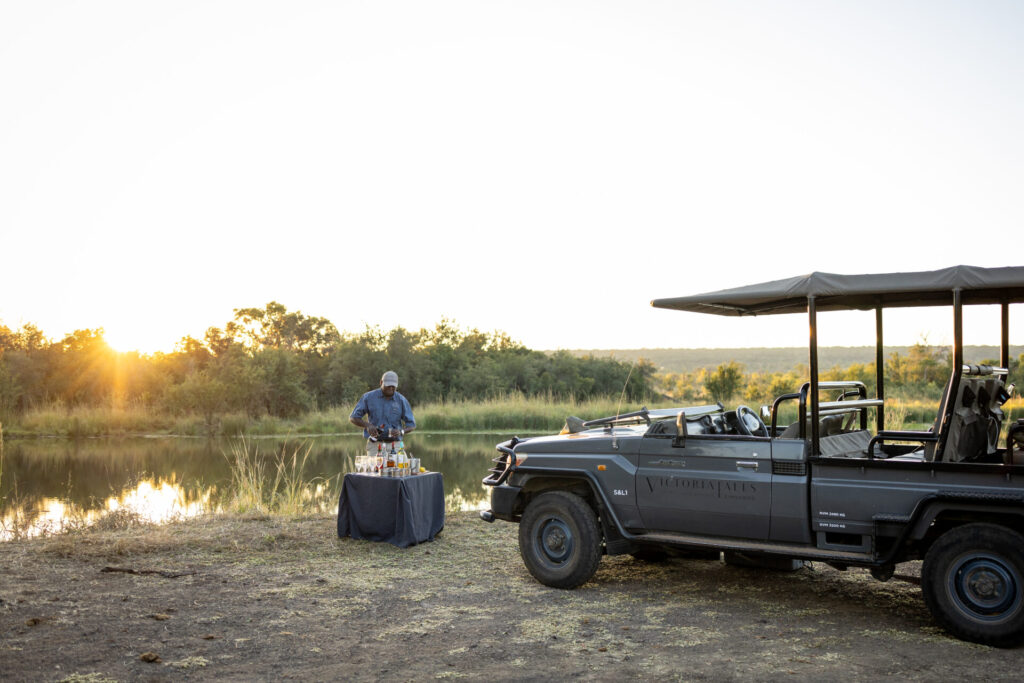
With drinks in hand, we talk beside the water as the last of the sunlight disappears into the distance, and listen to the occasional grunt of a hippo somewhere in the unfolding darkness. On our journey back to the resort, Hope switches on a red-light filter to search for nocturnal animals, illuminating the landscape in an eerie white glow that makes it look it’s been dusted with snow. I laugh to myself as I’m transported to the glens of Scotland; it’s an incongruous thought in the middle of the Zimbabwean bush.
A Wilderness Haven
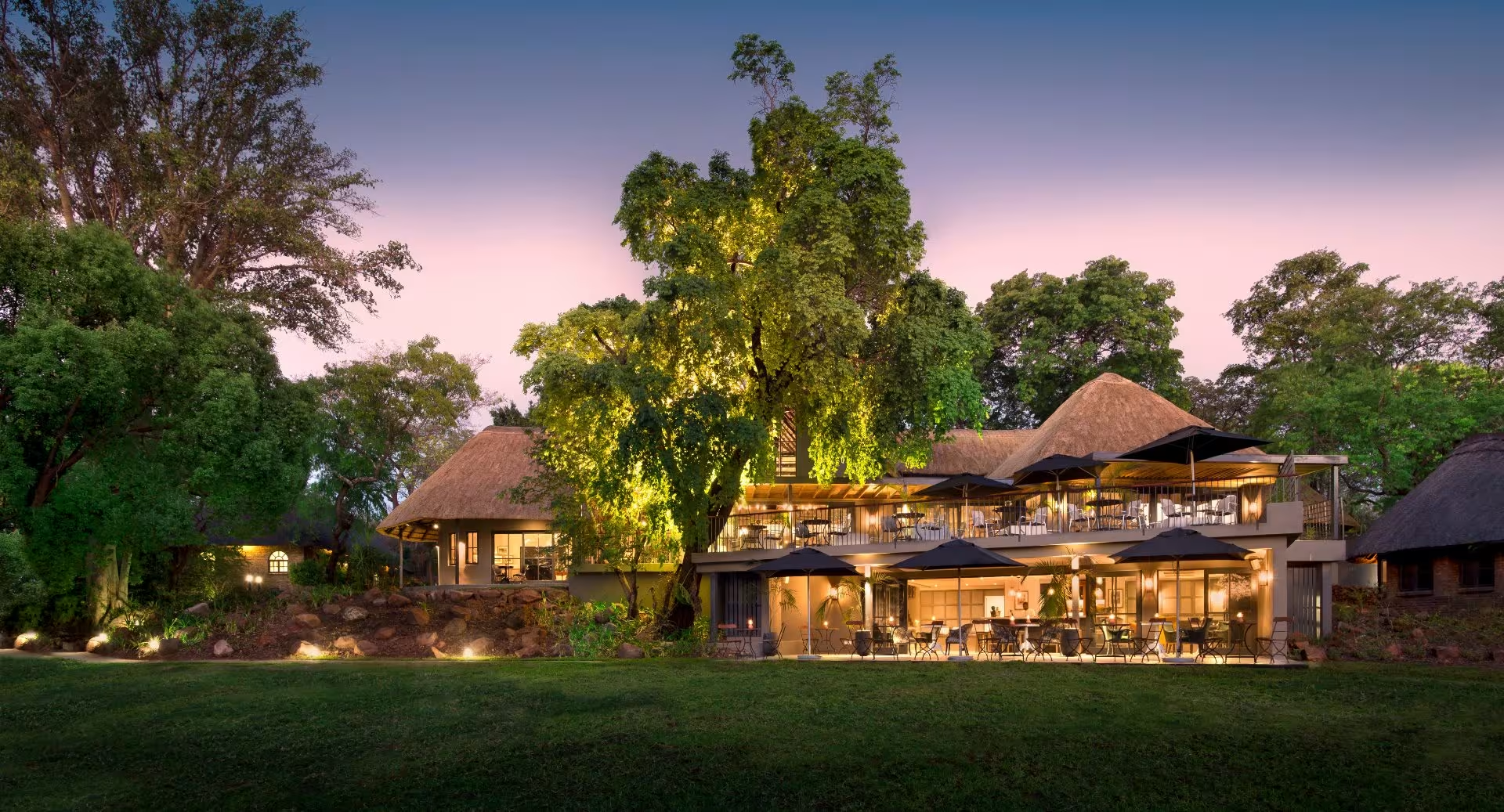
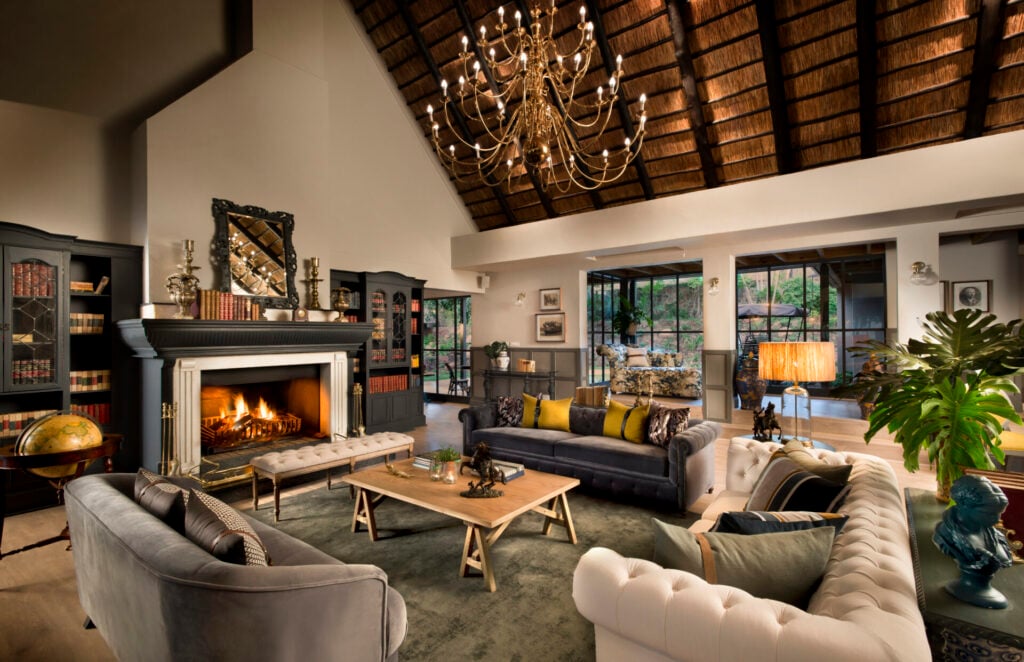
Back at Anantara Stanley & Livingstone, I’m mesmerised again, but this time by the skills of Anantara Stanley & Livingstone’s interior designer, Meg Ralph. En route to my suite, I walk through the impressive lounge, where soaring thatched ceilings, elaborate chandeliers and deep velvet sofas with leather belt-bound cushions create a contemporary interpretation of an African safari lodge. I admire an antique piano, an old writing desk, the enormous fireplace, and Chinese porcelain vases that sit alongside a collection of David Livingstone ornaments, whose work campaigning against the East African slave trade helped galvanise the abolitionist movement in Britain
Away from the main building, sixteen thatched-roof suites nestle amongst myriad trees and beautiful gardens, connected by winding stone pathways bordered by flowering shrubs in shades of pink, purple and red. In the daytime, butterflies flutter between the flowers, and don’t be surprised by the noisy electric-blue beetles that can come hurtling by with great gusto.
Hope tells us the call of the Cape turtle dove, sounds like ‘work harder’ in the morning and ‘drink lager’ in the evening. I’m not sure why its priorities change so dramatically, but I tend to agree with its philosophy
Birdsong provides a constant soundtrack here. During a morning walk with Hope, one of the reserve’s seven guides, we spot a southern red-billed hornbill, a crested barbet with its speckled chest and a starling whose dark feathers transform into brilliant turquoise as it catches the sunlight. Hope tells us the call of the Cape turtle dove sounds like ‘work harder’ in the morning and ‘drink lager’ in the evening. I’m not sure why its priorities change so dramatically, but I tend to agree with its philosophy
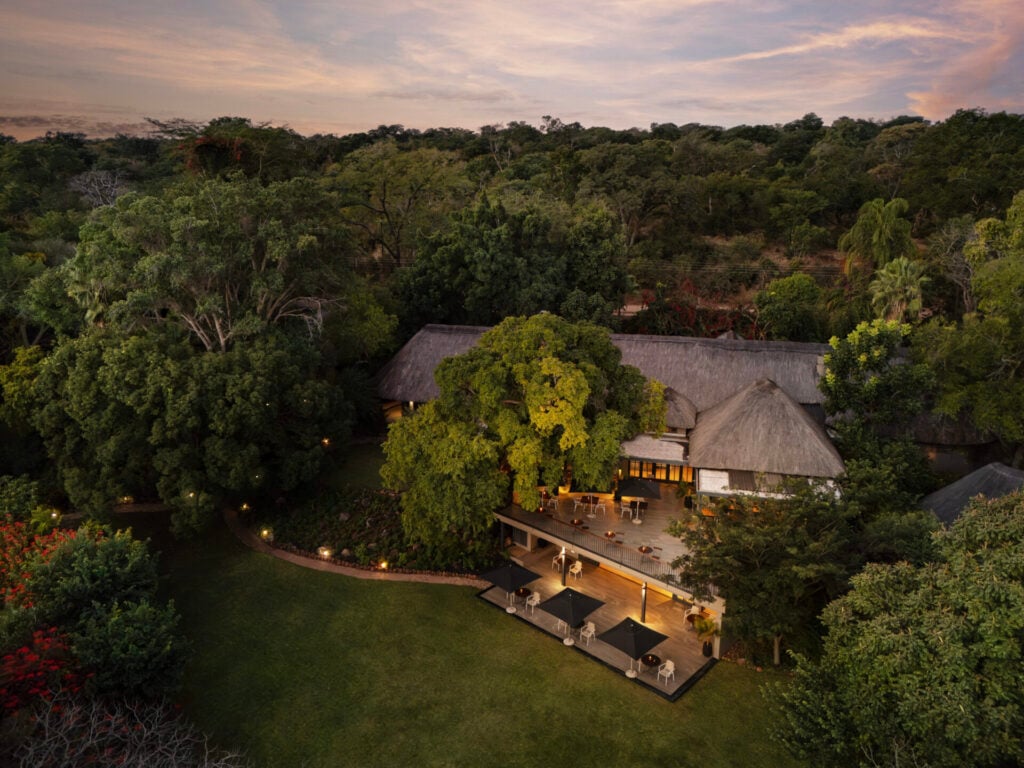
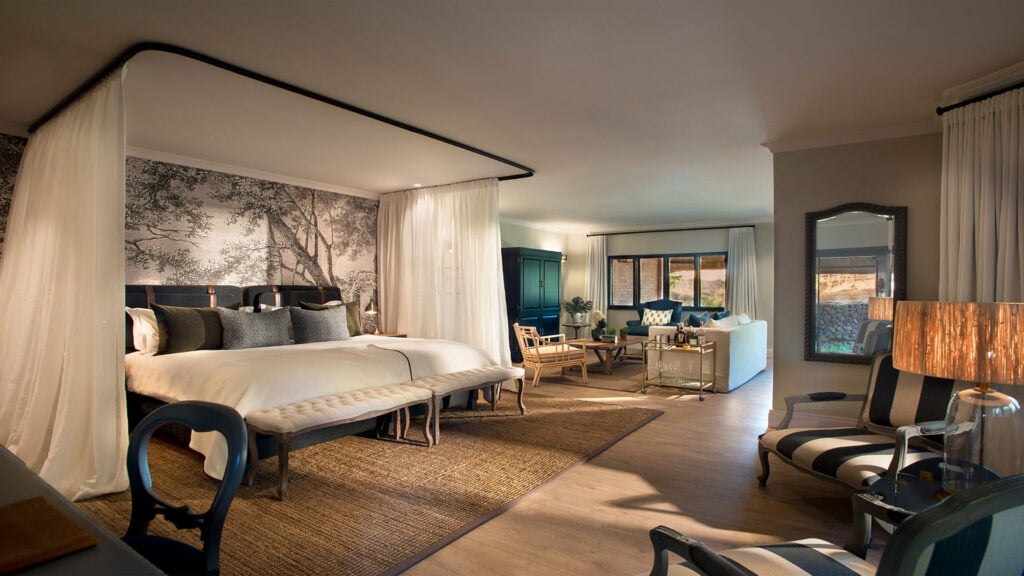
My suite is spacious, with a pleasing attention to local detail, from the baobab fruit to the locally produced beer in the minibar and flowers gathered from the gardens. The bathroom is stocked with refillable products from Healing Earth, an African skincare brand whose botanical formulations are cruelty-free, and a private balcony overlooking the grounds, the plains and a watering hole where guinea fowl, impalas and kudus wander freely throughout the day.
The watering hole became a circus, with a troop of baboons playing chase with some slightly less enthusiastic mongooses, kicking up clouds of dusty earth as the smaller animals tried to escape the antics
One afternoon while watching the watering hole from my balcony, the watering hole became a circus, with a troop of baboons playing chase with slightly less enthusiastic mongooses, kicking up clouds of dusty earth as the smaller animals tried to escape the antics. The impalas and kudus nearby lazily enjoyed the spectacle before continuing to graze.
The Smoke That Thunders
Of course, no visit to this part of Zimbabwe would be complete without witnessing the natural wonder that gives the town its name. A short drive from the hotel lies Victoria Falls National Park, home to one of the world’s largest waterfalls and part of a UNESCO World Heritage Site shared with neighbouring Zambia. Known locally as Mosi-oa-Tunya, or ‘The Smoke That Thunders’, Victoria Falls stretches for more than 1.7 kilometres along the Zambezi River before plunging into a series of dramatic gorges.
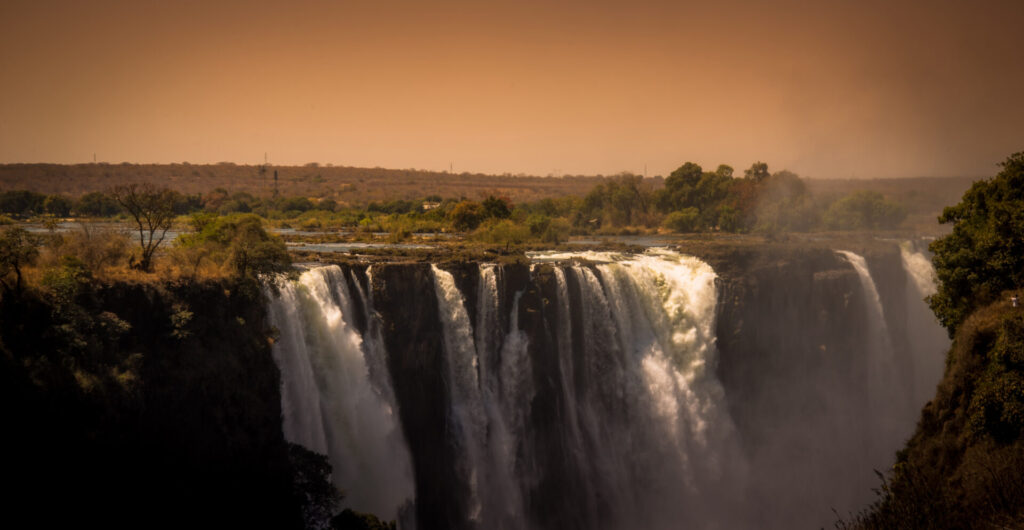
As we make our way along the rainforest paths, the sound of rushing water grows steadily louder until it’s almost deafening. And then, through a break in the trees, I catch my first glimpse of Victoria Falls. And what a sight it is. An enormous wall of water plunges into the gorge below, sending great clouds of spray billowing into the air, while farther along, the Zambezi tumbles over the cliff edge in what seems like a never-ending cascade. We wander between the 18 viewpoints, stopping every few metres to take in another section of the falls, although at times it’s difficult to see much at all through the mist. At one particularly exposed spot, we’re drenched within seconds, as though someone has turned a giant shower on above our heads. Yet a few metres farther along, the path is completely dry and the sun is shining.
Back at the hotel that evening, we’re halfway through dinner when a commotion outside catches our attention. Five elephants have appeared at the watering hole, prompting a mass exodus from the dining room as guests and staff hurry out to watch. Apparently, this doesn’t happen often, and judging by the excitement, I can believe it. We spend the next twenty minutes watching them drink and amble around the water’s edge, before eventually returning to our rather neglected dinner.
It’s been quite a few days, from coming face to face with endangered black rhinos to standing before the thundering Victoria Falls, and now sharing our last evening with a family of elephants. Of course, there’s still the small matter of that leopard I missed outside my suite, but I suppose it’s only fair that the wildlife gets to decide when, and indeed whether, it wants to make an appearance. I’ll just have to come back and try my luck again.
Visit anantara.com for more information,