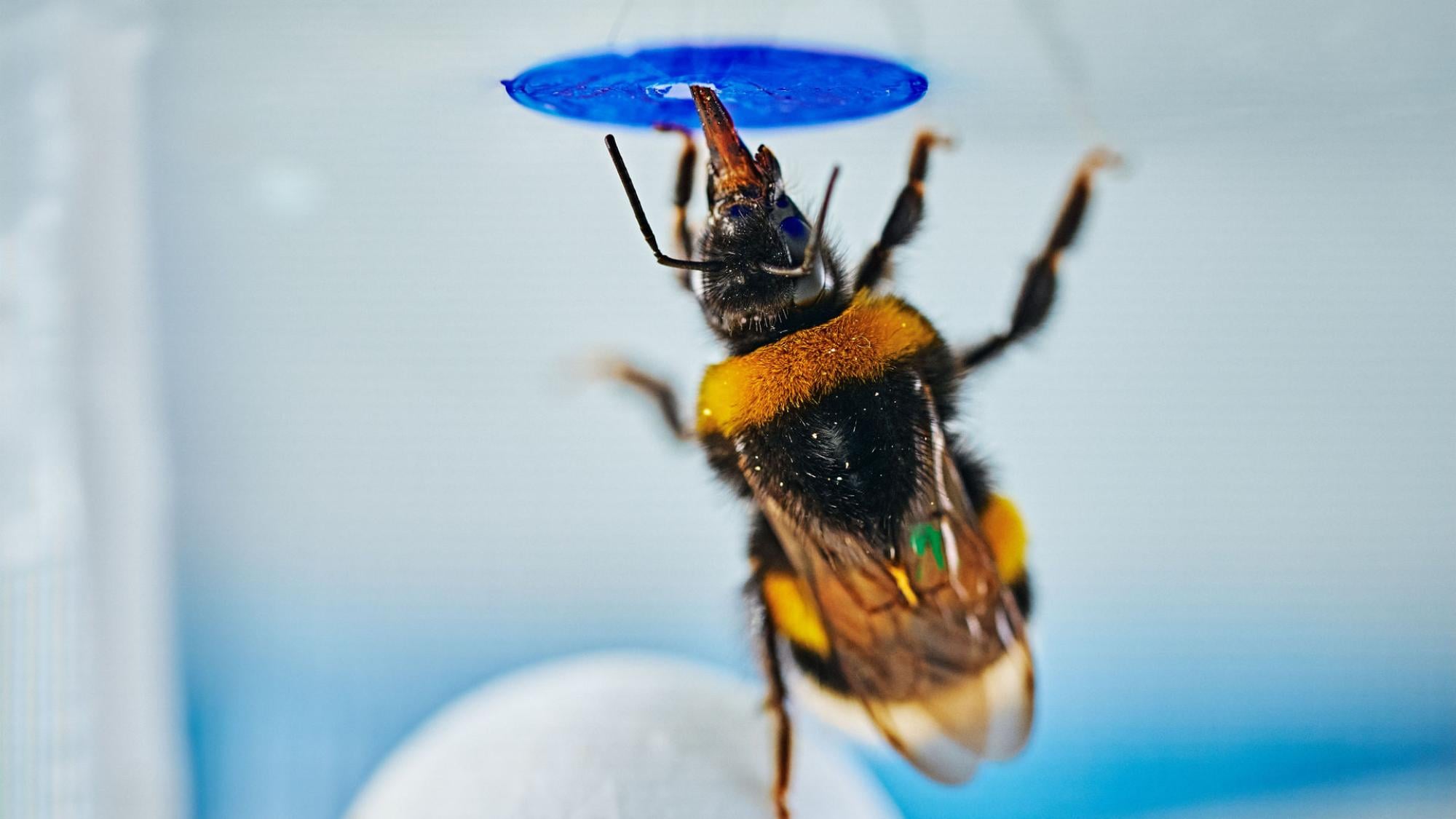
Bumblebees are the latest species known to use tools to solve a problem, following an experiment that identified reasoning and cognitive traits.
The insects were given an adapted version of an experiment that, 100 years ago, first demonstrated that chimpanzees could work out how to retrieve a hard-to-reach banana by stacking boxes, conducted by animal psychologist Wolfgang Kohler.
Since then, various other primates, elephants, and crows have joined species known to be capable of this level of insight and spontaneous problem solving.
In the latest research, conducted in the Finnish universities of Oulu, Helsinki and Turku, bumblebees were shown to be able to roll a polystyrene ball to a specific location and climb on to it in order to access an artificial flower on a low ceiling.
‘Most people think insects are reflex-based machines,” said Dr Olli Loukola, a behavioural ecologist at the University of Oulu, Finland, and senior author of a report into the study which was published in the journal Science.
‘That they can’t have any emotional states or feel pain. Some people don’t even realise that they have brains. I hope that these results change the worldview about that.
‘We are not claiming that bees think like humans. But our findings show that miniature brains can generate flexible solutions to novel problems in ways we are only beginning to understand.’
Bumblebees and spontaneous problem-solving
The bees, which were only a couple of weeks old, were first trained to associate a blue artificial flower with a reward of sugar water.
The flower was then moved to the ceiling of a transparent petri dish-style chamber whose ceiling was too high for them to reach, but with insufficient space for them to hover.
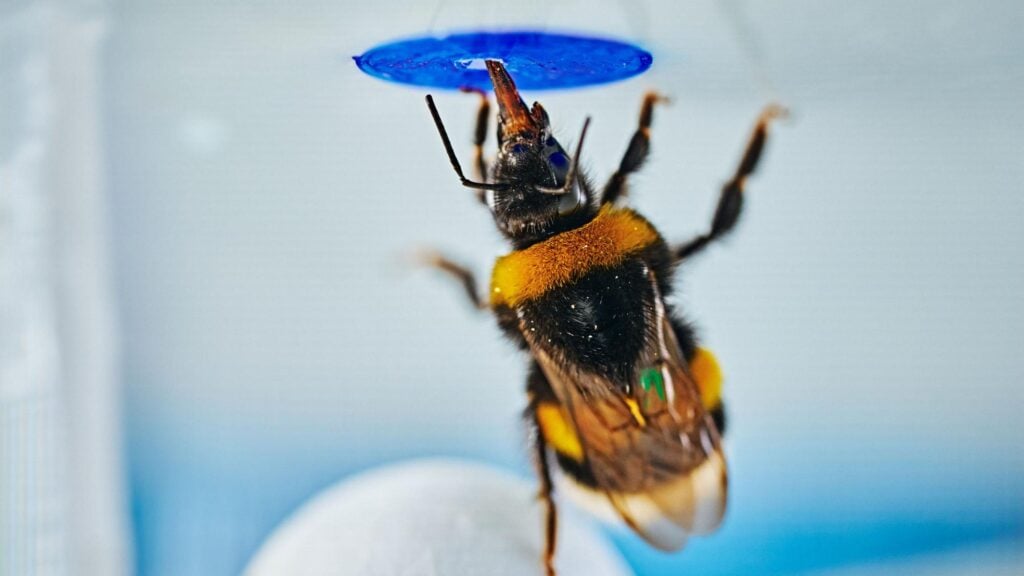
A ball was introduced into the chamber, and in order to reach the flower, the bumblebee had to roll the ball under it and climb on top – a behavioural trait they had never been trained to do.
In the most basic version of the test, 75 per cent of the bees were successful in reaching the flower.
‘This is essentially an insect version of the classic ‘box-and-banana’ problem,’ said Loukola in a press release. ‘The animal must realise that an object can be repositioned and then used as a tool to reach an otherwise inaccessible goal. What stands out about the result is that this kind of spontaneous problem solving is now demonstrated in an insect.’
To test whether the activity was purely the result of chance, the scientists put the bumblebees through increasingly complex versions of the challenge.
In the most complex arrangement the bees were allowed to explore a left and right chamber, one of which featured the artificial flower, before the ball was introduced.
The scientists then illuminated the chamber with red light, preventing the bees from seeing the blue flower, and introduced the ball. To complete the task, the bees needed to recall the location of the flower and position the ball beneath it – and 23 out of 30 bees were successful.
‘One moment the animal is exploring seemingly without direction, and the next it performs a highly efficient sequence of actions leading directly to the solution,’ said report co-author Ece Nur Akmeşe from the University of Helsinki. ‘Watching the bees solving the task was genuinely fascinating.’
Professor Lars Chittka, a behavioural ecologist at Queen Mary University of London, the author of The Mind of a Bee, added: ‘We’ve seen bees do all kinds of remarkable things in our lab: counting, impressive object manipulation – but they surprise me every time. This is the clearest demonstration yet of some kind of comprehension of what’s at stake.’