The People’s Choice Wildlife Photographer of the Year competition shortlist has been released by its organisers the Natural History Museum, London.
Entries include a mountain of deadly snares confiscate by anti-poaching rangers, a crab hitching a ride on a jellyfish and a camouflaged spider.
The contest features a lineup of twenty-four images in the running to be crowned the winner of the Wildlife Photographer of the Year Nuveen People’s Choice Award 2026, with online voting now open to anyone, anywhere in the world.
The shortlisted photographs were chosen from 60,636 entries from 113 countries and territories. Here are 12 of the 24 entries. To see the others, or to vote online for the winner of the Nuveen People’s Choice Award 2026, visit the website here:
Portrait of Extinction – Adam Oswell
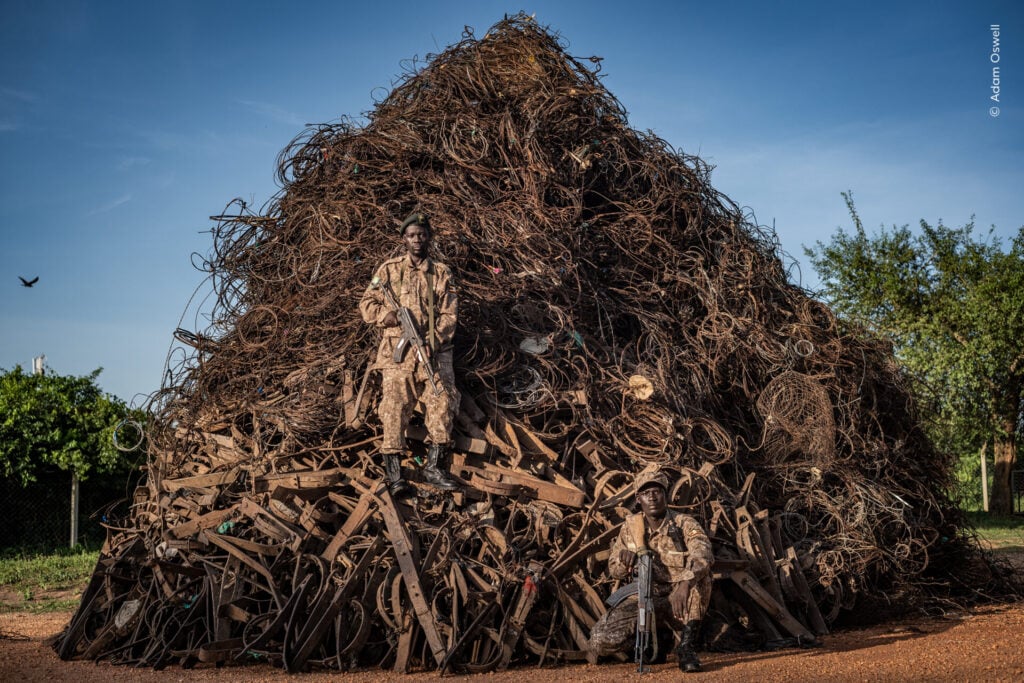
Portrait of Extinction by Adam Oswell (Australia) shows a mountainous pile of confiscated snares lies behind Uganda Wildlife Authority Rangers. This huge pile consists of snares that had been confiscated over a one-year period in Murchison Falls National Park. Adam joined several rangers and community volunteers to build it. They wanted to show the scale and urgency of the snare crisis in Africa. It took a week to build.
Flying Rodent Josef Stefan
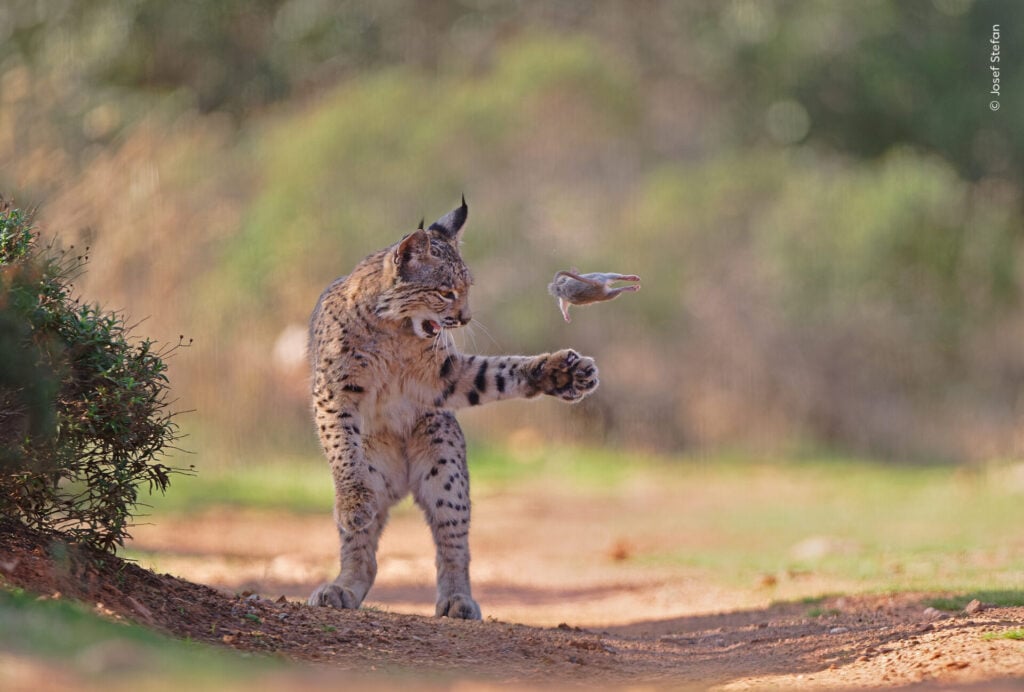
Flying Rodent Josef Stefan (Austria). Here a young lynx playfully throws a rodent into the air before killing and devouring it. Josef has wanted to photograph lynxes for a long time, spending two weeks observing them from a hide at Torre de Juan Abad, Ciudad Real, Spain.
Beauty Against the Beast – Alexandre Brisson
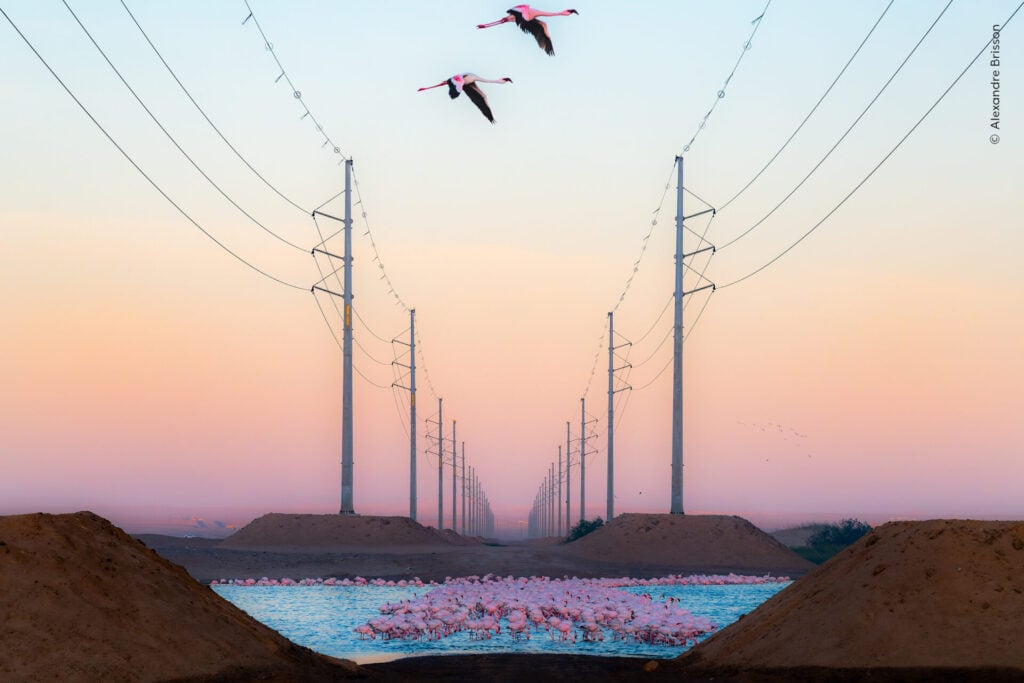
Beauty Against the Beast is the work of Alexandre Brisson (Switzerland) depicts a group of flamingos against a stark industrial backdrop of power lines. After a 10-hour drive, Alexandre arrived at this bird sanctuary in Walvis Bay, Namibia, just as the sun was setting. The smell from a nearby open-air dump was overwhelming, a sharp contrast to the beauty of the flamingos.
Along for the Ride – Chris Gug
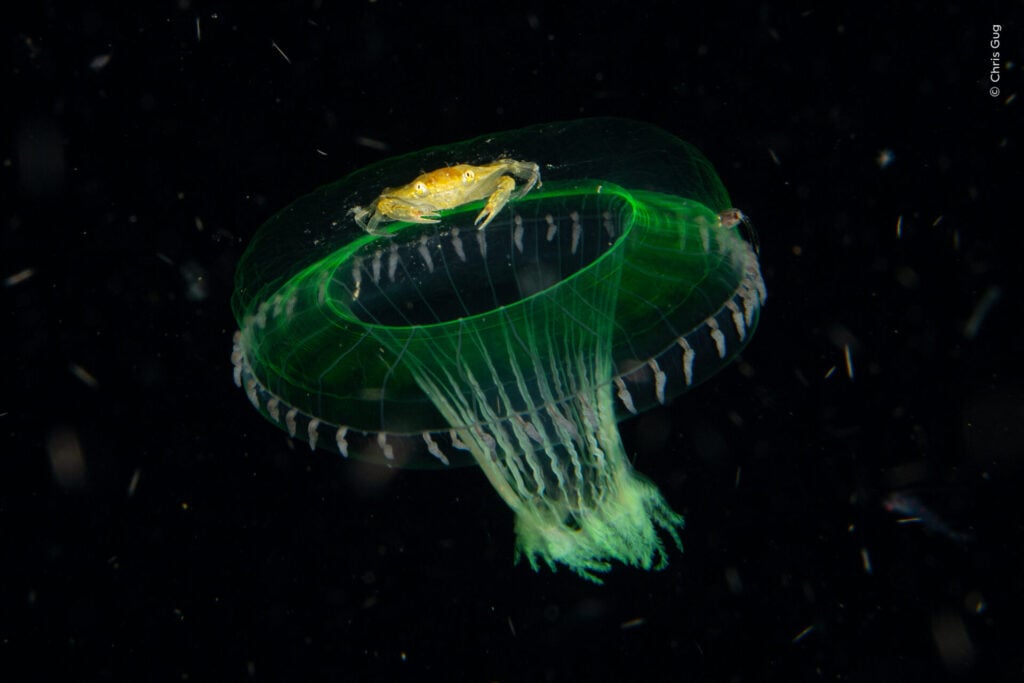
Along for the Ride was entered by Chris Gug (USA). Against the darkness of the night-time sea, it shows a juvenile swimming crab hitching a ride on a jellyfish. Chris spotted this scene while scuba diving at night in Lembeh Strait, North Sulawesi, Indonesia. The relationship between the crab and the jellyfish is not clearly understood. The crab could be catching a ride to save energy. It could be using the stinging tentacles as protection from predators. Or it could be using the jellyfish as a platform to spy out small fish to eat.
Above and Below – Charles Davis
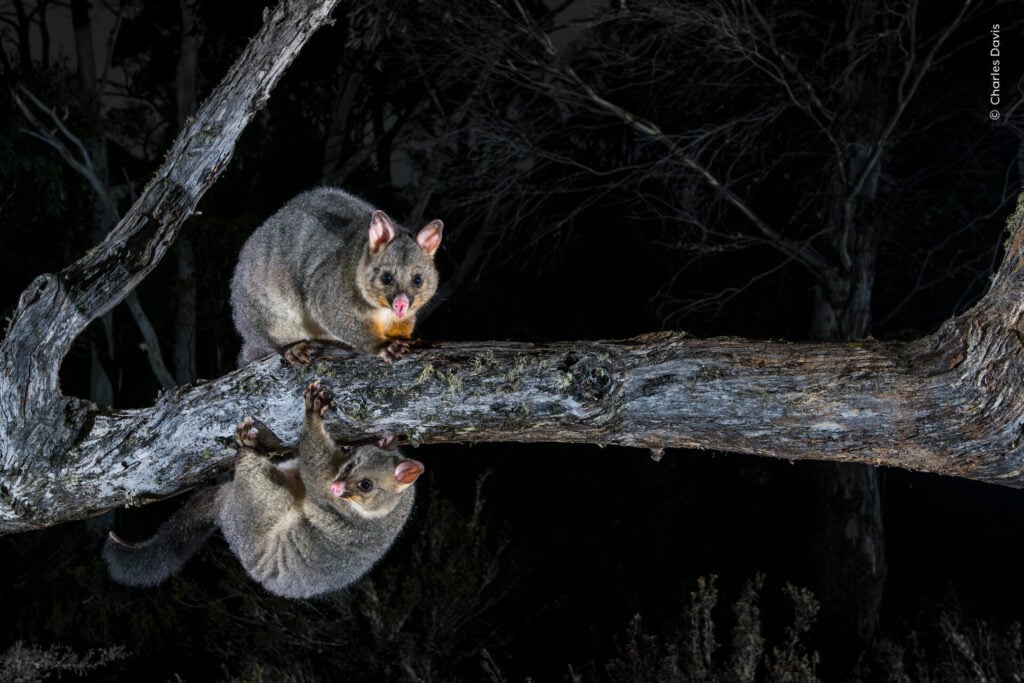
Above and Below by Charles Davis (Australia). This pictures shows a brushtail possum joey as it mirrors its mother climbing a branch while out foraging. Over a month, Charles set up a camera trap on this branch in Miena, Tasmania.
Swirling Superpod – Cecile Gabillon
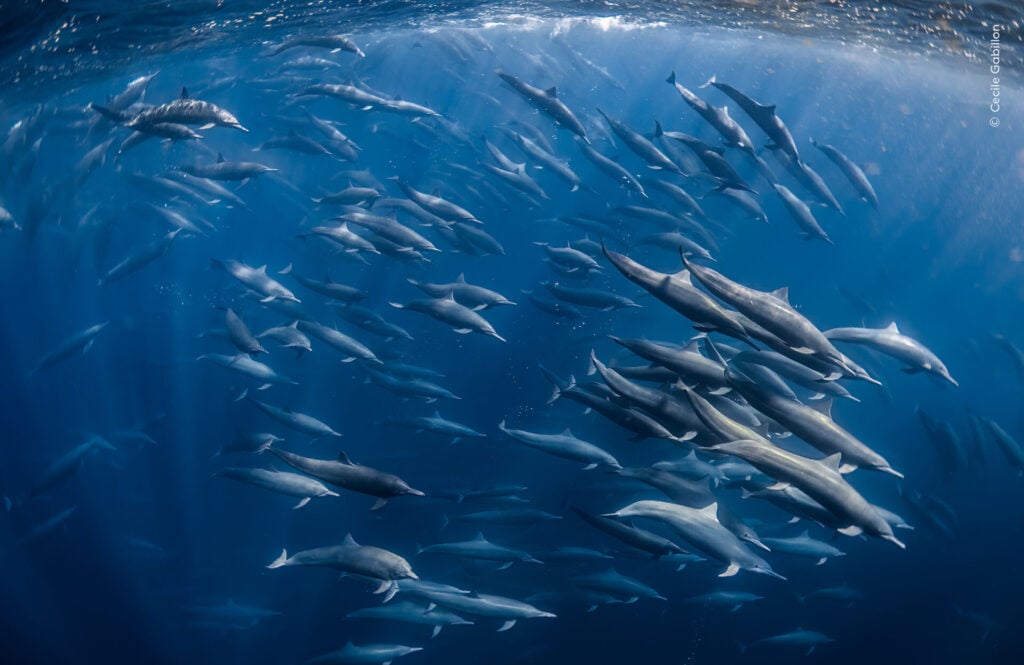
Swirling Superpod is by Cecile Gabillon (France) and captures a spectacular superpod of spinner dolphins herding lanternfish towards the surface of the ocean. Cecile was free-diving in the Pacific Ocean, near Costa Rica, when she came across the dolphins. Cecile was swimming so hard to keep up with them that it was almost impossible to take pictures. She says that being surrounded by these dolphins was one of the most amazing encounters of her life. Sadly, pollution and overfishing are making these massive groups rarer.
Couple’s Camouflage – Artur Tomaszek
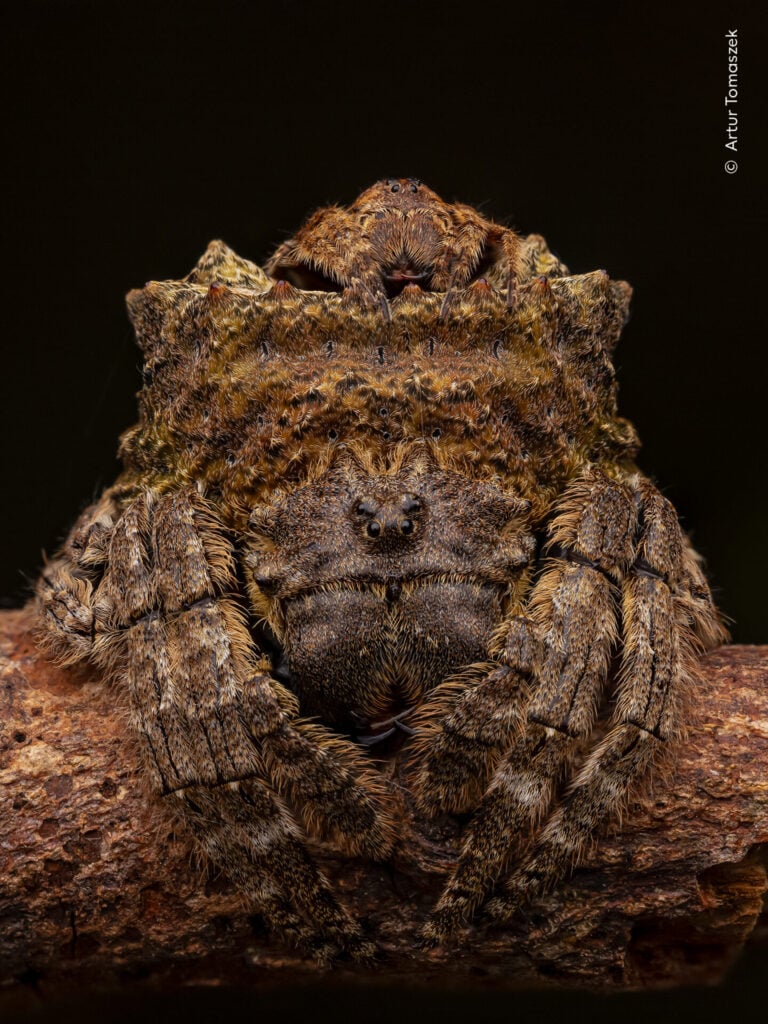
Couple’s Camouflage Artur Tomaszek (Poland) shows a male on the abdomen of a well-camouflaged female broad-headed bark spider, waiting until she moults and is ready to mate. Artur was lucky to encounter these broad-headed bark spiders in Khao Phra Thaeo Non-Hunting Area, Phuket, Thailand. The spiders spend the day on the bark of a tree and go down to their webs when it gets dark.
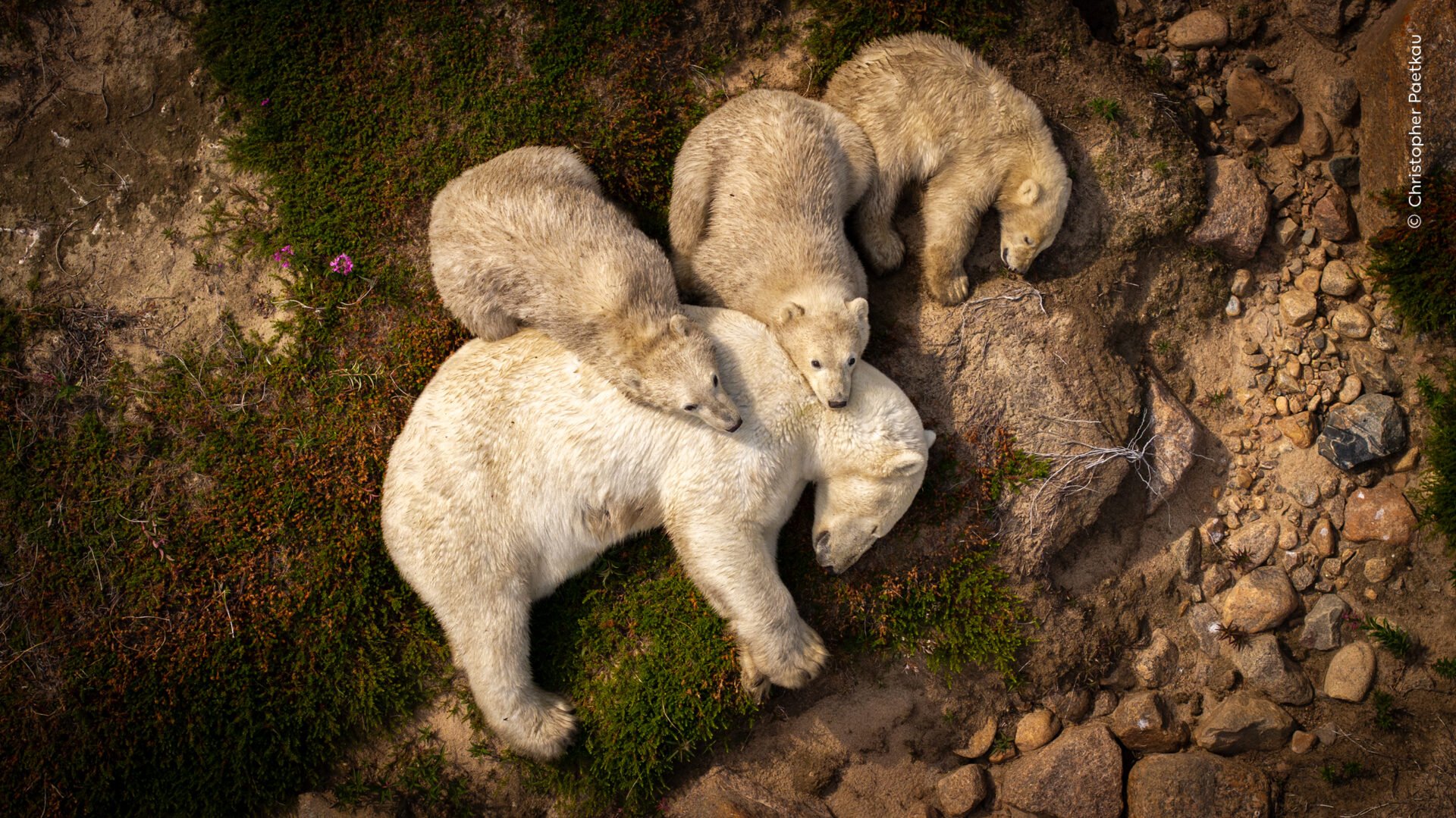
Family Rest Christopher Paetkau
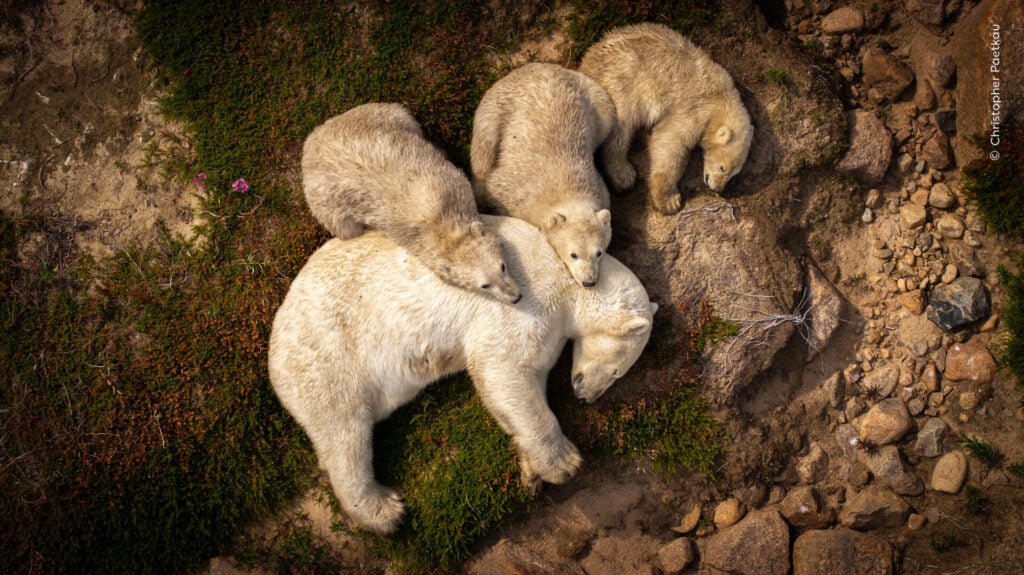
Family Rest Christopher Paetkau (Canada) shows a mother polar bear and her three cubs as they pause peacefully in the summer heat. This type of scene is getting rarer. The sun is high, the land wide and open. The polar bears rest after their long journey north along the Hudson Bay coast in Canada. Shrinking sea ice is making it harder for polar bears to hunt and find food to survive in summer. This is a story of endurance and a fleeting moment of hope in a world where survival is anything but certain.
Uniqueness Daniela Anger
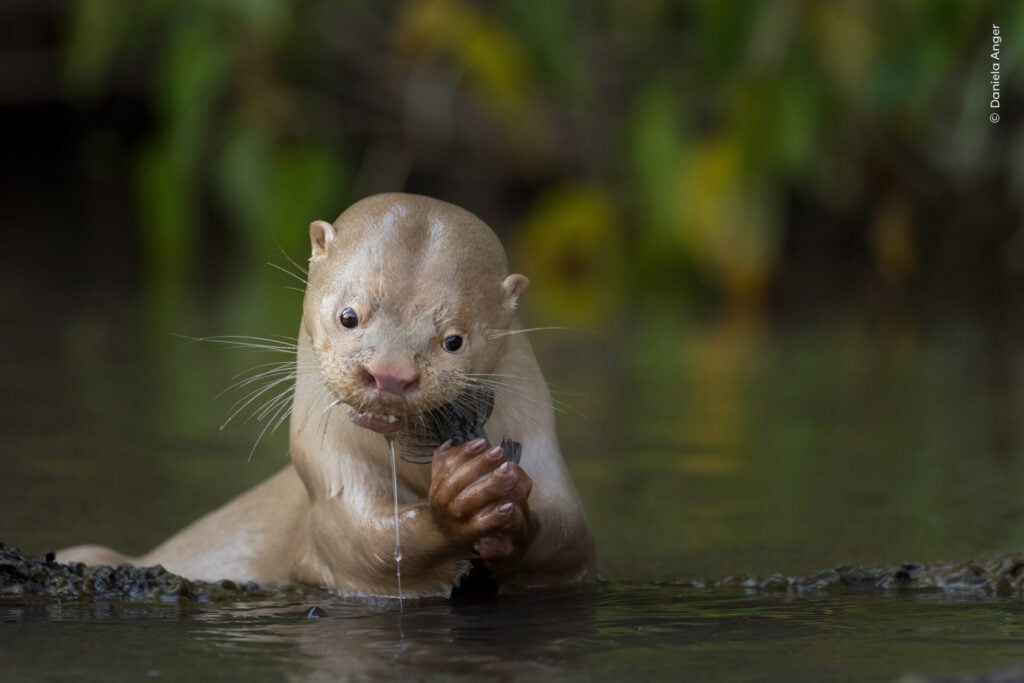
Uniqueness Daniela Anger (Germany) documents a leucistic otter as it feeds on a catfish in Mato Grosso do Sul, Brazil. On holiday in the southern Pantanal, Daniela was keen to see the neotropical river otters that live in the Aquidauana River. After many boat trips, she spotted this otter feeding on a catfish. It has leucism, a lack of melanin, resulting in pale or white fur. Animals with this condition can be more vulnerable as they don’t have their normal camouflage.
Marvellous Spatuletail Dustin Chen
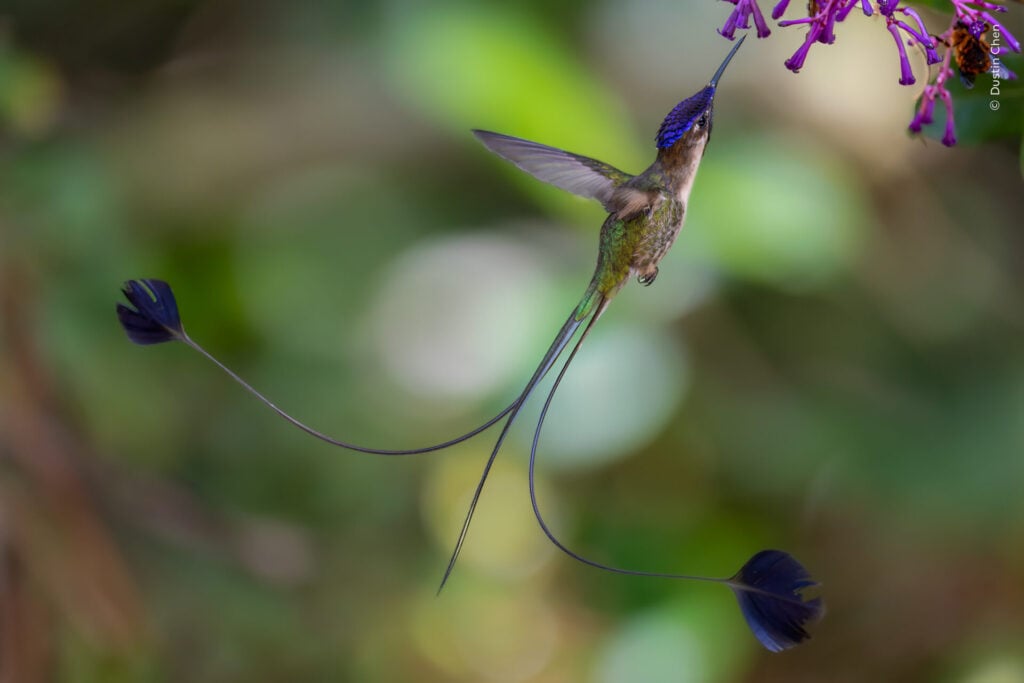
Marvellous Spatuletail Dustin Chen (UK). Here a male marvellous spatuletail hummingbird shows off its long tail while it feeds on flowers. Dustin spent two weeks watching birds at Huembo Lodge in Pomacochas, Peru. This male marvellous spatuletail hummingbird was his main focus. In Dustin’s photo, the bird shows off its long tail while feeding on flowers. The spatuletail uses its impressive tail to attract females.
Solar Waves Francesco Russ
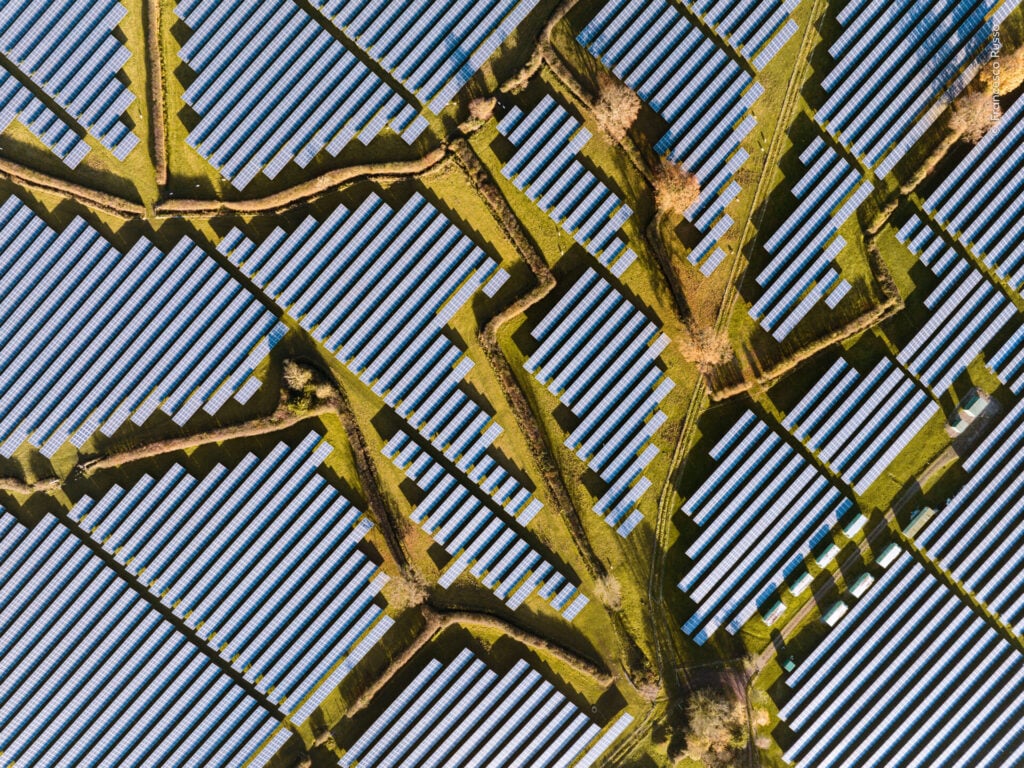
Solar Waves Francesco Russo (UK/Italy) shows rows of solar panels stretch across the English landscape like ripples on a water’s surface. The panels had to be carefully organised around the divisions between pastures. The result is a pattern that resembles the shapes of bodies of water. This image is part of a project to document the relationship between nature and industry along the River Severn, which flows near this solar farm.
Hold Me Tightly Dvir Barkay
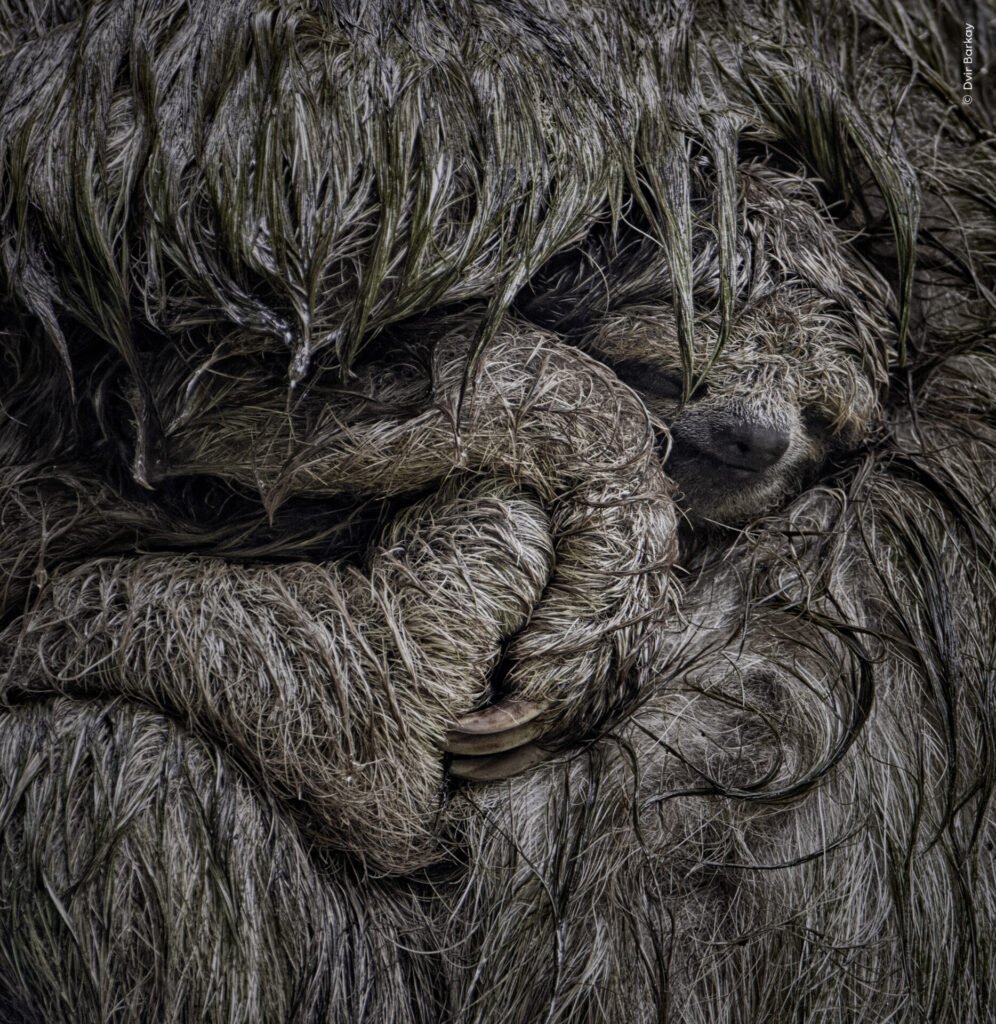
Hold Me Tightly Dvir Barkay (USA) illustrates a brown-throated three-toed sloth mother as she cradles her young in her arms to shelter it from the rain. Dvir observed this mother and her baby at La Selva Biological Station in Costa Rica. They spent most of their time high up in the canopy. Brown-throated three-toed sloths aren’t the world’s fastest animals – in a week, they moved between just three trees.