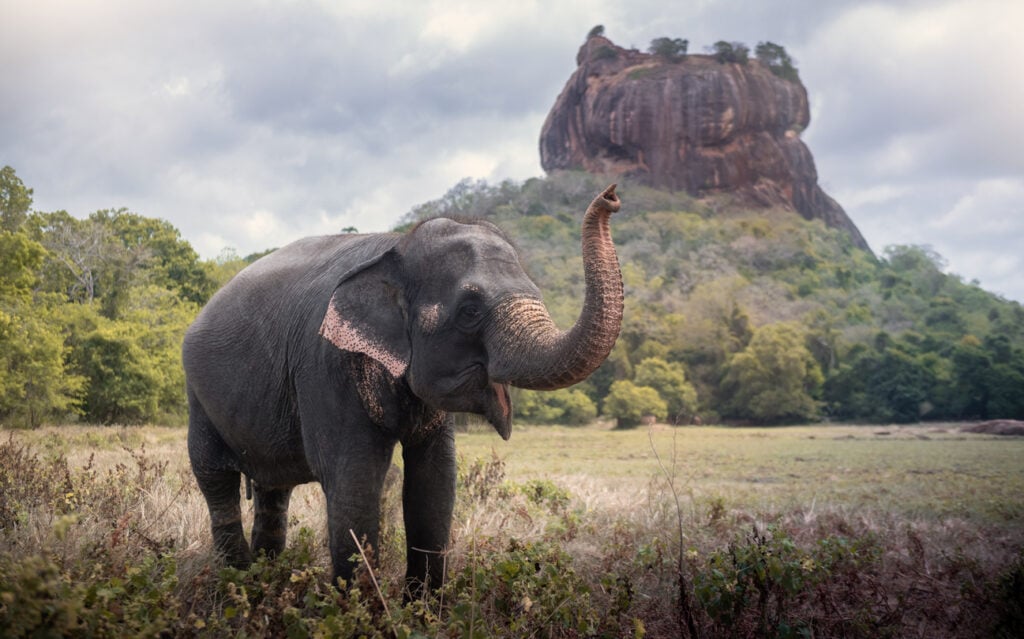
A wild elephant is blocking the path to my villa at Uga Ulagalla, a hotel within 58 rural acres in Sri Lanka’s central, cultural triangle, and this isn’t just any old elephant either. It is the third largest tusker in Sri Lanka, that goes by the name of Agbo, famous throughout the island for surviving several attacks during elephant-human conflict, including gunshot wounds.
‘Agbo considers the hotel his territory and, of course, it is,’ explains Uga Ulagalla’s resident naturalist, Sakun Lakshan, whose job, alongside running the property’s Elephant Conservation Centre and guiding guests on nature excursions, includes ushering Agbo, gently but firmly, from the property before he demolishes the organic kitchen garden (again).
While this chance meeting is a thrill for me, it’s a real concern to Uga Ulagalla’s gardeners as their vegetable beds have only just recovered after the last time Agbo trampled through (something that rural farmers throughout Sri Lanka face the daily threat of). We observe him from a distance (although close enough that I can see gunshot scars on his hind legs), then we retreat to higher ground as Sakun issues a series of commands and Agbo moves on. Later, I learn it was a close call, as Agbo picked up speed close to the garden, only to be successfully diverted at the last second. What next, I wonder, an actual elephant in the room?
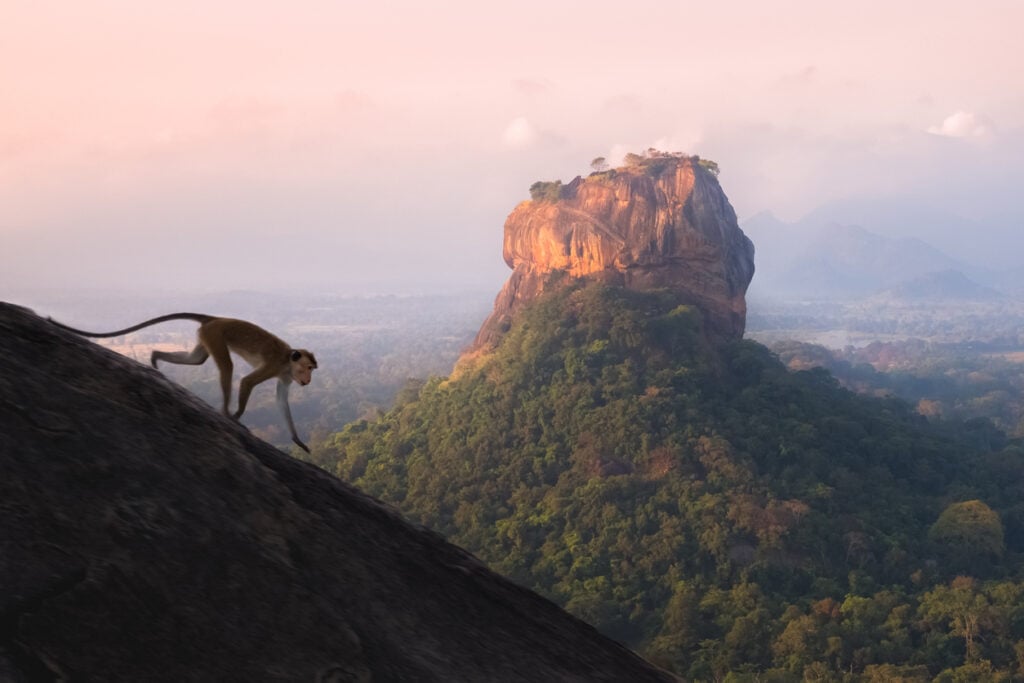
At Sigiriya, King Kasyapa’s mighty rock fortress, I make the knee-crunching 1,200 step climb for endless views over jungle and forest, barely changed since Kasyapa’s reign in 477-495 CE.
Sri Lanka’s cultural triangle is an area of great historic significance, home to two former kingdoms, ancient temples and monasteries, which teems with wildlife. Uga Ulagalla sits in idyllic countryside, around a thirty-minute drive from Anuradhapura, a sprawling monastic Buddhist city dating back 2000 years, home to towering, ancient stupas, around which white-clothed devotees walk clockwise, while chanting prayers.
It’s not my first time to the region and by the time I reach Uga Ulagalla, I’ve visited three out of four of the region’s UNESCO World Heritage Sites, including the riotously vibrant 2000-year-old Dambulla rock caves, covered entirely in decorative frescoes and lined with Buddha statues. At Sigiriya, King Kasyapa’s mighty rock fortress (an immense chunk of magma from a long-worn-away volcano), I make the knee-crunching 1,200 step climb for endless views over jungle and forest, barely changed since Kasyapa’s reign in 477-495 CE.
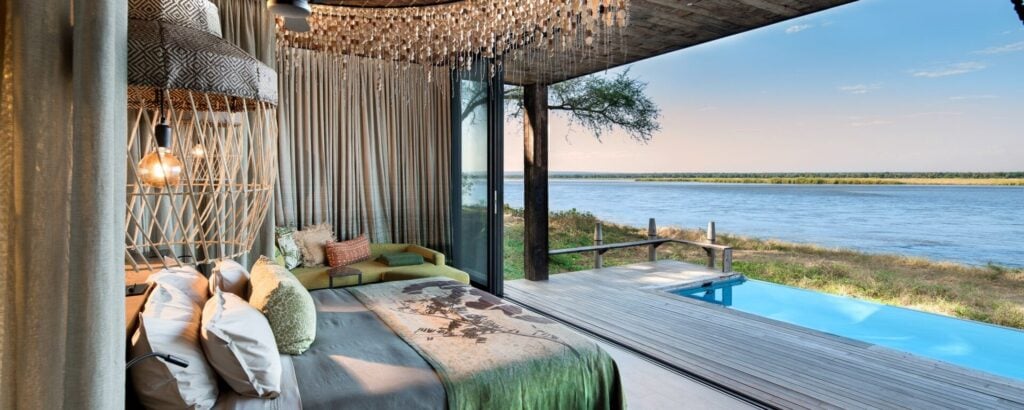
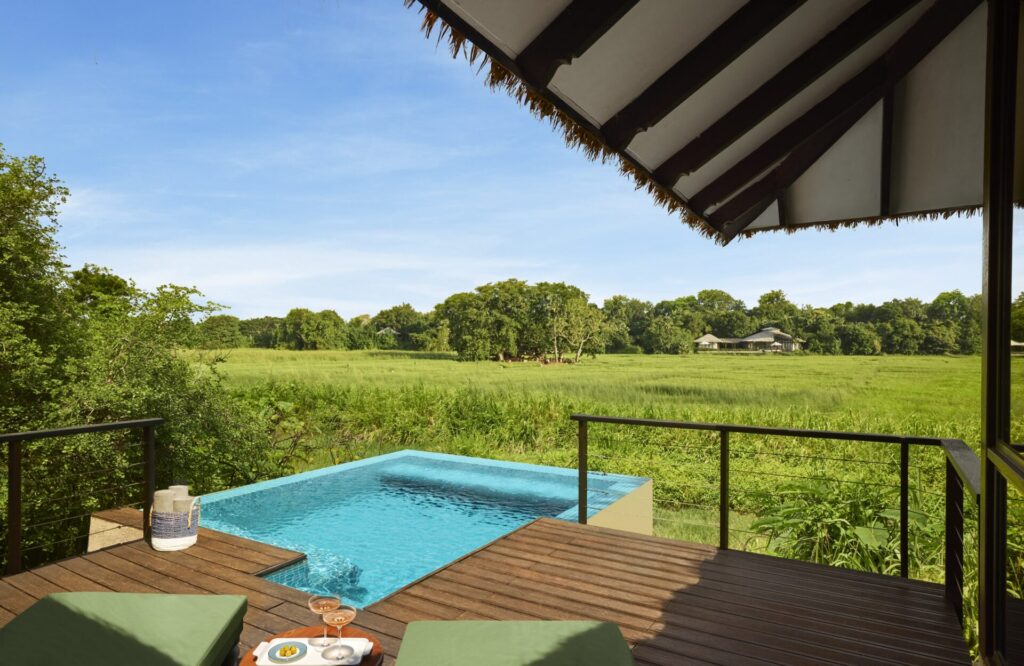
Now, I’m ready for some days immersed in nature, and it’s obvious from the get-go that Uga Ulagalla will deliver. There are four spotted house geckos in the hallway of my villa, close to my plunge pool I see Purple rumped sunbirds and Little green bee-eaters, and in my shower there’s a harmless bronze-back frog that I name Dilshan. The black-faced langurs also clearly think they own the place; the elders of the group sit in a line at the property’s gates as a unique welcoming committee.
During breakfast, I watch a group of juvenile langurs dive bomb from frangipani trees into an ornamental pool, emerging with bedraggled fur, only to repeat the fun again. ‘Looks like a fun pool party,’ jokes the waiter
During breakfast, I watch a group of juvenile langurs dive bomb from frangipani trees into an ornamental pool, emerging with bedraggled fur, only to repeat the fun again. ‘Looks like a fun pool party,’ jokes the waiter. What I already love about the hotel is there is no shooing away of wildlife. Beyond a few deterrents, such as the netting over the open sides of the restaurant (although the Indian palm squirrels and House sparrows still find a way through), the ethos here is that we are the trespassers and must learn to fit in.
On my first visit to Sri Lanka, some fourteen years ago, it took a little while to accept that wild elephants really could appear at any given moment and that it was not uncommon to see one by the roadside or close to a village or town. I soon learned that although the elephant is tied to Sri Lankan history and tradition, and often a symbol of devotion, their modern relationship with man isn’t an easy one as they fight for territory amid a fast-growing human population.
This realisation was cemented as I watched a large bull elephant turn over a tuk-tuk, which my guide at the time explained as the elephant taking revenge on the tuk-tuk driver, who had most likely wronged it. Although, the tuk-tuk driver on this occasion wasn’t badly hurt, deaths of both elephants and humans, due to conflict of this kind, occur every year.
Elephants have been in steady decline by an estimated 50 per cent over the last three generations, mainly due to deforestation, and are now listed as endangered, with around 6,000 remaining. Three-quarters of these live outside of protected national parks.
Teeming with Wildlife
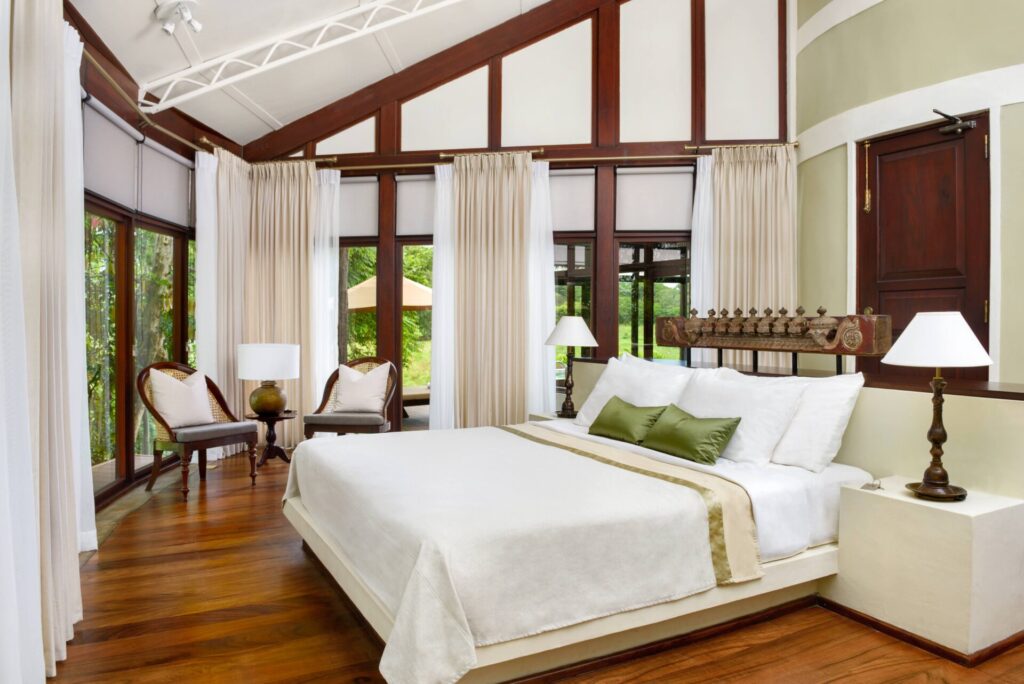
Wildlife rich Uga Ulagalla is a lovely place to kick-back in for a few days, with nineteen-one-and-two-bedroom villas dotted though expansive grounds that include lagoons and working paddy fields.
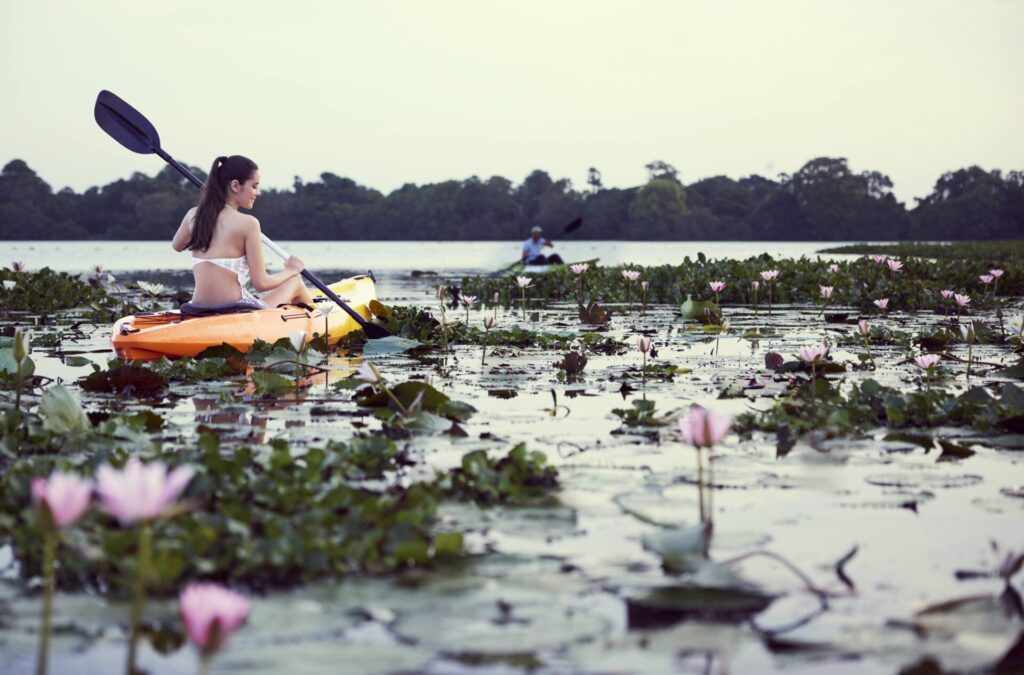
Nature-based activities are led by Sakun and his team and on my first morning I glide by kayak over a water lily and lotus flower filled lagoon, amid bobbing Pelicans, wading Indian pond herons and quick flitting Pygmy kingfishers. ‘Just last week we had elephants here,’ Sakun tells me. ‘During the dry season they come to bathe and drink, but those weren’t as bold as Agbo and didn’t venture on to the property.’
On my first morning I glide by kayak over a water lily and lotus flower filled lagoon, amid bobbing Pelicans, wading Indian pond herons and quick flitting Pygmy kingfishers
With over one hundred species of birds recorded in the grounds alone, today it’s our feathered friends that captivate: Oriental darters, Asian paradise flycatchers, Purple swamphen, and White-throated kingfishers. I make a mental note of these pleasingly descriptive names as I paddle towards a Cormorant, wings outstretched to dry in the sun.
Although I’m keeping my fingers crossed for more elephant encounters, there’s no shortage of other wildlife.
As the grounds are vast, every villa comes with bikes (although you’re advised to order a golf buggy come night fall) and a slow pedal is the best way to soak up the tropical beauty of the place. Plus, you never know quite what you’ll cross paths with, like the metre-long monitor lizard I meet on my way to a cookery lesson and the macaques and Indian peafowl that happily graze together in a recently harvested rice paddy.
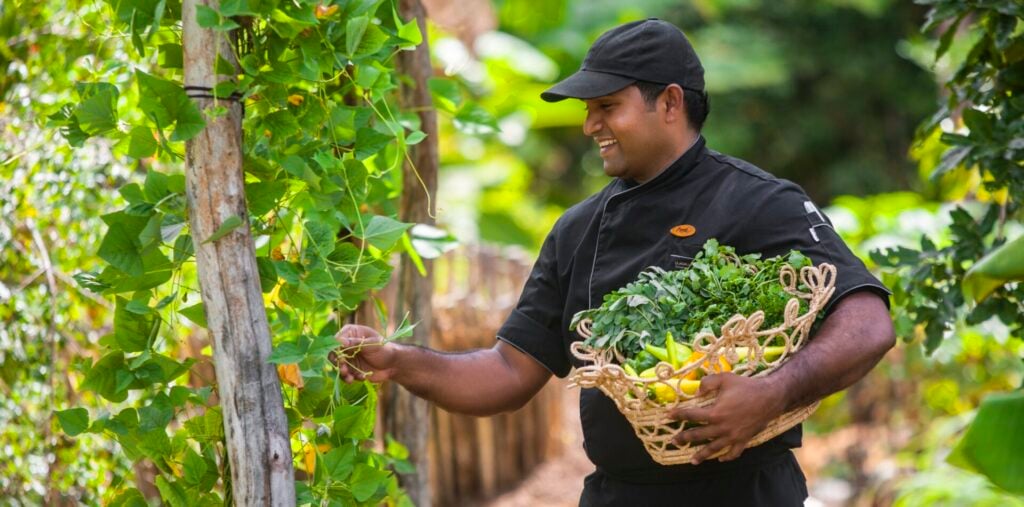
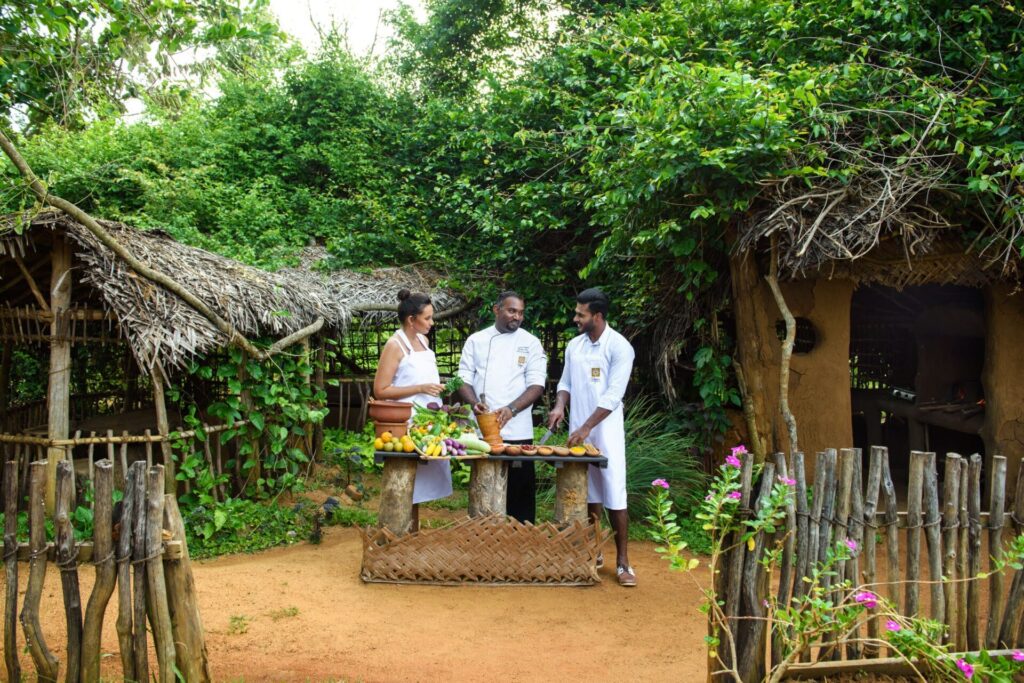
Even during the cookery lesson, held in an outdoor kitchen within the organic garden, wildlife is a distraction. While I’m learning to rustle up Sri Lankan stalwarts such as dhal, coconut sambol, prawn curry and brinjal moju (a spicy aubergine dish using curry leaves, mustard seeds, ginger and hot green chillis), an Indian peafowl wanders through, tail feathers on display.
All guests are encouraged to pay a visit to Uga’s Elephant Conservation Center (ECC), established by Katharina Raaben, Uga Resort’s head naturalist.
Learning to Live Alongside Elephants
‘It was in 2021 that our cameras first recorded a group of bull elephants close to the property and leading that group was a magnificent tusker. This was our first encounter with Agbo, and I could never have imagined how significant this elephant would become. From then, we began to log their movements, including time sighted, location, group structure, and any other details,’ she explains. ‘We became increasingly aware of the pressure the elephants put on the local community. Some loved Agbo, others hated him. In June 2023, I received a call telling me that Agbo had been injured by a trap gun (a trap set for smaller animals that Agbo had stepped on and triggered).’
There’s no skirting around how brutally wild elephants can be treated. The use the so-called watermelon bombs, when explosives are packed tightly into a hollowed-out watermelon, are one of the most barbaric
Although Agbo had survived previous injuries, Katharina and her team were worried that this time he would not pull through. ‘He wandered into Uga Ulagalla exhausted and clearly in pain, with a severe injury to his left leg, so we quickly informed the Department of Wildlife Conservation and their veterinary team.
‘We worked closely with them during Agbo’s recovery, which took months and was often set back by infections and fresh wounds. Because he had limited mobility, he couldn’t roam far, which was very stressful for farmers in the immediate vicinity, but for many this was also the first time they’d seen Agbo in daylight hours. Witnessing his vulnerability and pain gave them a different perspective. Unexpectedly, Agbo’s story attracted attention and ignited new discussions country-wide about elephant-human conflict and the need to protect and support both sides.’
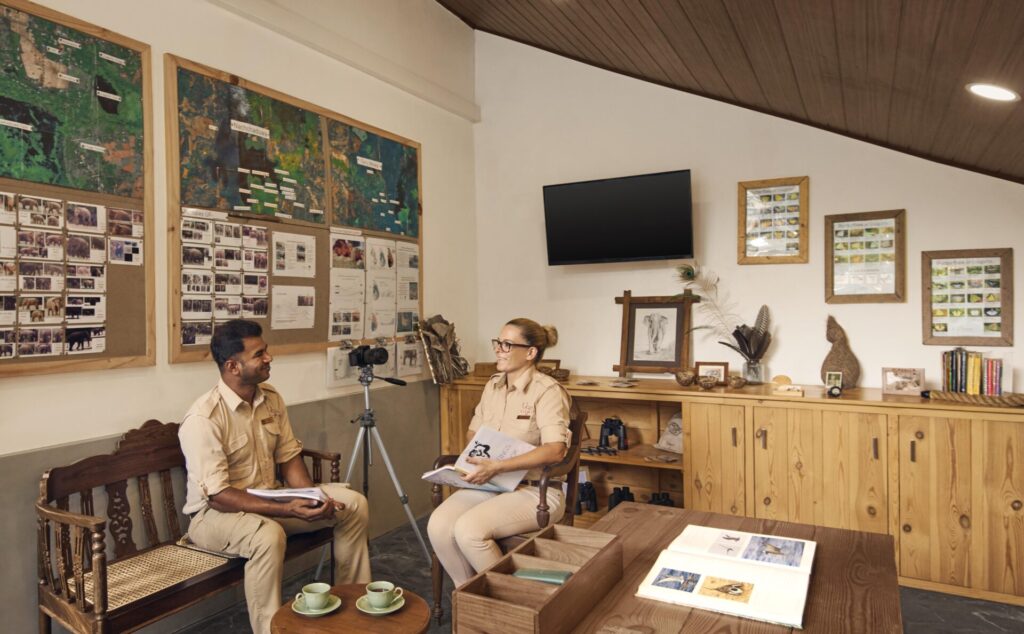
I spend time at the center, where walls are covered in maps, photographs and charts explaining the problems elephants face in an increasingly shared landscape with man. There’s no skirting around how brutally wild elephants can be treated. The use the so-called watermelon bombs, when explosives are packed tightly into a hollowed-out watermelon, are one of the most barbaric.
‘When I was a child, I lived in a mud house very close to the jungle and an elephant destroyed it,’ Sakun tells me. ‘It pushed in the walls while we were inside, so I didn’t have much love for elephants for a long time. My perspective changed when I started working at Uga Ulagalla and I realised that we have a responsibility for how we live alongside them. Agbo has become a very important part of my life and when he was recently injured, I was very fortunate to play a part in his care.’
I meet the flower-stealing torque macaques at Aukana, a 14-metre tall, 5th century Buddha statue carved straight from the rock, which remains off the tourist radar. Here, the macaques wait until devotees place their offerings of lotus flowers then treat the altar like an all you can eat buffet
One of the ECC’s biggest initiatives has been working closely with the local community in establishing fences to protect farms. I take a nature-focused jeep expedition with Sakun, spotting a pair of Malabar pied hornbills, a Brown fish owl, and Crested hawk eagle as we explore the wilderness close to Uga Ulagalla. A second fence has recently been completed, in a collaboration with community leaders and Sri Lanka’s Center for Conservation and Research, working closely with Dr. Prithiviraj Fernando, a leading expert in human-elephant conflict.
The first fence was completed in 2023 and has successfully protected 70 families in the nearby villages of Pittala Konderama and Karambe. The newest electric fence protects a further 65 farming communities and 132 acres of agricultural land. It’s a sustainable solution, designed to deter the elephants but doesn’t disrupt their natural movements or access to wildlife habitats. ‘Although the fence issues a mild electric shock, it’s harmless, acting more as a psychological deterrent than an impenetrable barrier,’ Sakun explains. ‘It won’t stop them if they’re determined but it does make them think twice.’
An Encounter With The Gathering
Elsewhere in this region, I encounter wildlife at every twist and turn. While exploring the region’s lesser-known ancient sites, I meet the flower-stealing torque macaques at Aukana, a 14-metre tall, 5th century Buddha statue carved straight from the rock, which remains off the tourist radar. Here, the macaques wait until devotees place their offerings of lotus flowers then treat the altar like an all you can eat buffet. Again, there’s no chasing away of the monkeys. Local people happily tolerate them, appearing to take as much delight as I do in their cheeky antics.
I sense the festivity of the gathering immediately as we reach the wide-open fields that lead down to the water, where herds of up to one hundred are feeding on grass, and I’m reminded that nothing quite prepares you for seeing elephants on masse
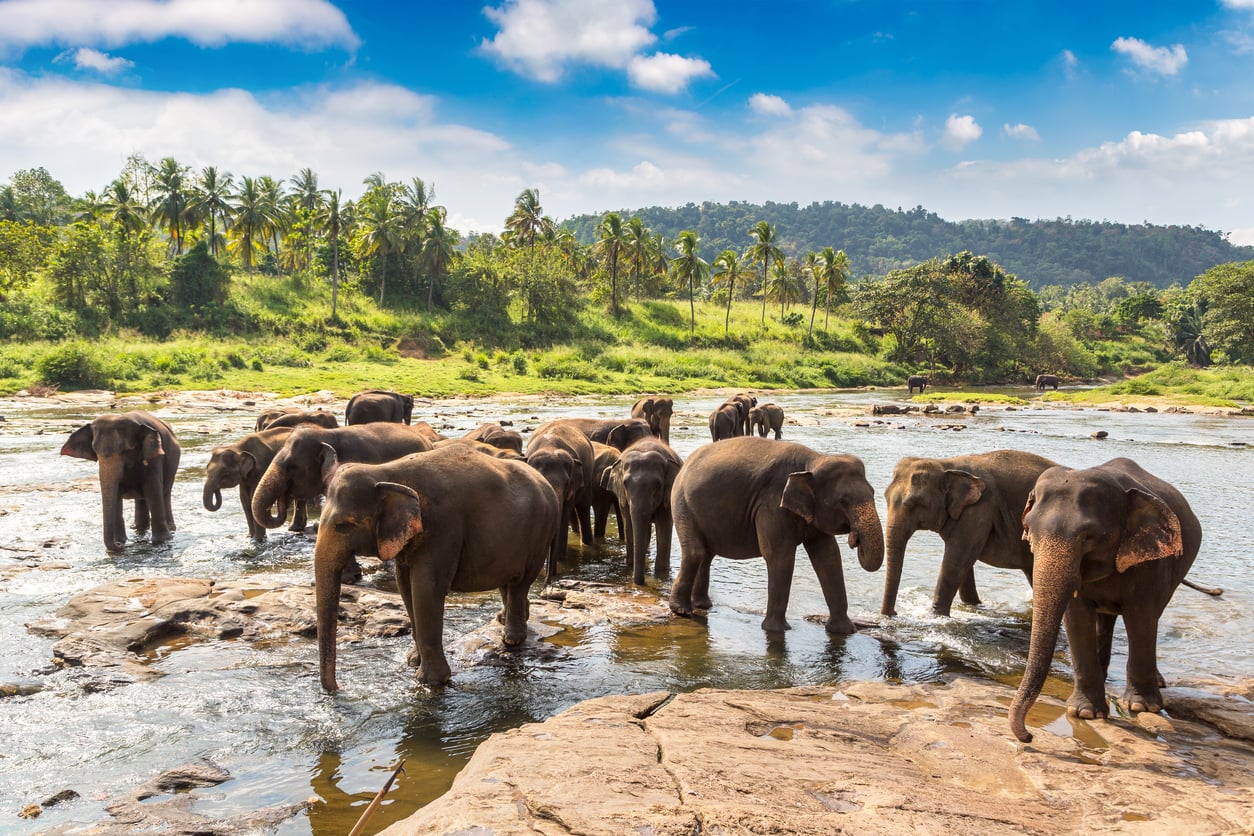
Close to Minneriya National Park (a 45-minute drive from Uga Ulagalla) I see wild elephants roaming close to the main road. Here, between July and October each year, hundreds congregate at the national park in one of Asia’s greatest spectacles, known simply as The Gathering.
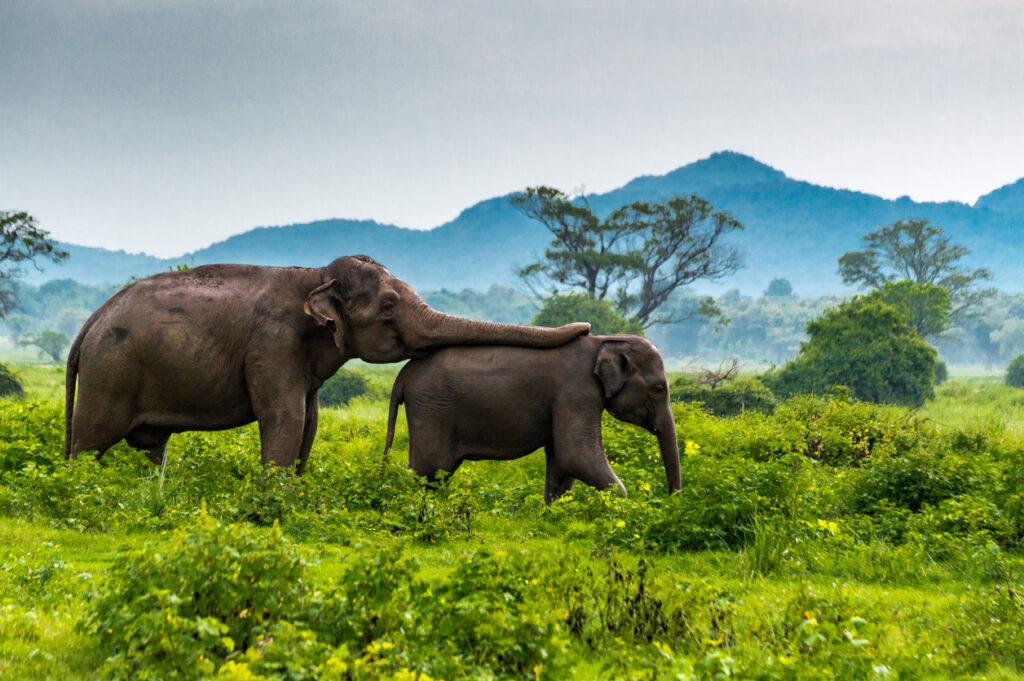
‘We’re nearing the peak of the dry season, so they come here come to drink at the receding waters of the reservoir,’ the ranger explains as we set off from the park’s main gates. ‘These are sociable animals that greet one another as friends. Mothers with calves will spend time together, and older youngsters will play fight and chase one another. It’s more than the necessity to drink that drives them here. There’s a great feeling of kinship and it’s an opportunity to strengthen bonds and even find a mate.’
I sense the festivity of the gathering immediately as we reach the wide-open fields that lead down to the water, where herds of up to one hundred are feeding on grass, and I’m reminded that nothing quite prepares you for seeing elephants on masse and that the sheer power of these animals should never be underestimated.
Though peace-loving animals, we watch as one flaps its ears back and forth in a warning, then takes an alarming step towards a safari vehicle that is blocking the road; giving it a shoulder barge before it carries on.
‘What you just saw is usual,’ the ranger is quick to explain. ‘All vehicles must stay on the road and move on if an elephant is approaching, particularly when a bull elephant is in musth, and testosterone is high. The driver wasn’t quick enough, so the elephant taught him a lesson.’
From a distance, we spend an hour in awe, observing the family dynamics and their constant tactile interaction in the use of their trunks to gently caress one another. We watch as two young males wade into the reservoir, immersing themselves so fully that only the tip of their trunks remains visible, like a built-in snorkel.
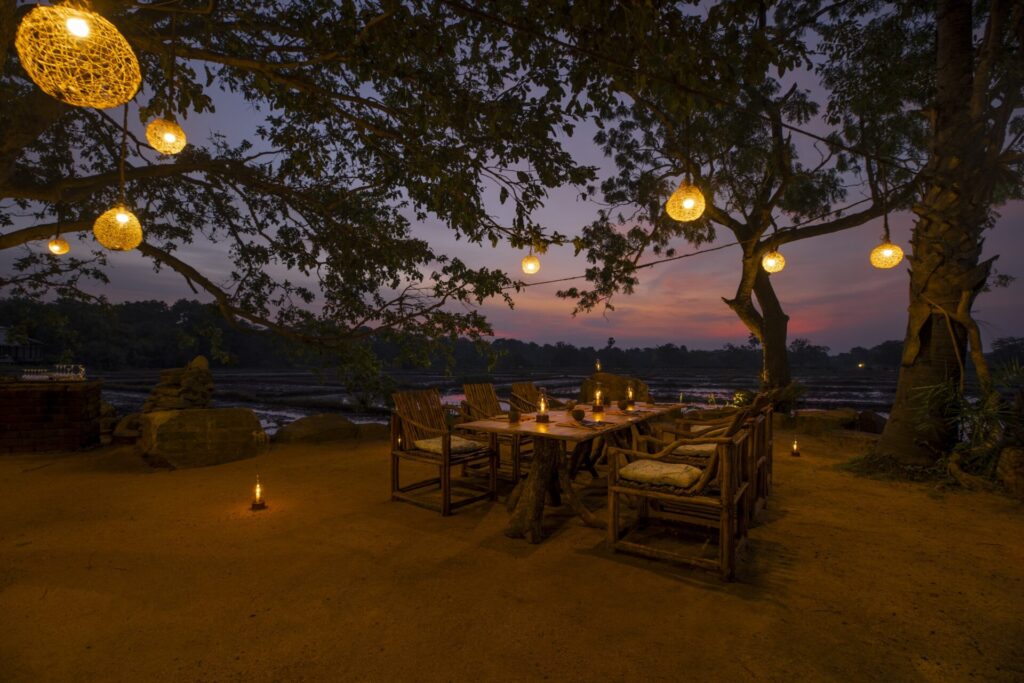
Back at Uga Ulagalla, I settle down for a feast at Kamatha, the hotel’s signature Sri Lankan restaurant located at the epicentre of a paddy field, with a menu of twenty-five, centuries-old, dishes. Rumour has it that Agbo has been seen again, moving by moonlight, as is his preference, surprisingly stealth-like like for such a large, hulking beast. Tonight, under the light of a full moon, his gleaming white tusks will be the first to give him away. From then on, I tune into every snap of branch, every screech of Indian peafowl or hoot of owl, but although I don’t cross paths with Agbo again, it’s such a thrill to know he is there.
Kate stayed at Uga Ulagalla. From £360 for a pool villa, including breakfast, based on two people sharing. www.ugaresorts.com
About Uga Ulagalla
A commitment to sustainability and the local community lies at the heart of Uga Ulagalla. Recent community projects include the building of facilities and donation of supplies to local schools and investment in local infrastructure including the donation of water tanks to local villages. A dedicated sustainability team works hard to surpass the Global Sustainable Tourism guidelines. Initiatives include hiring and training local staff; growing produce on site; use of solar panels; reduction of water waste; ban on single-use plastics. Watch this space: setting a precedence for hotel chains within Sri Lanka, Uga Resorts has plans to establish more wildlife research centres.
Two Brilliant wildlife conservation organisations in Sri Lanka worthy of a donation:
Sri Lanka Wildlife Conservation Society
Committed to the preservation of endangered wildlife through research and community engagement www.slwcs.org
Wildlife & Nature Protection Society Sri Lanka
Conserving endangered species, protecting diverse ecosystems, and addressing climate change. Engaging with local communities on elephant-human coexistence www.wnpssl.org
Kate travelled with Red Dot Tours, experts in bespoke Sri Lanka holidays. From £2,540 per person for a 10-day Simply Sri Lanka holiday, staying at Uga Resorts’ boutique properties, including private transportation, excluding international flights. www.reddottours.com