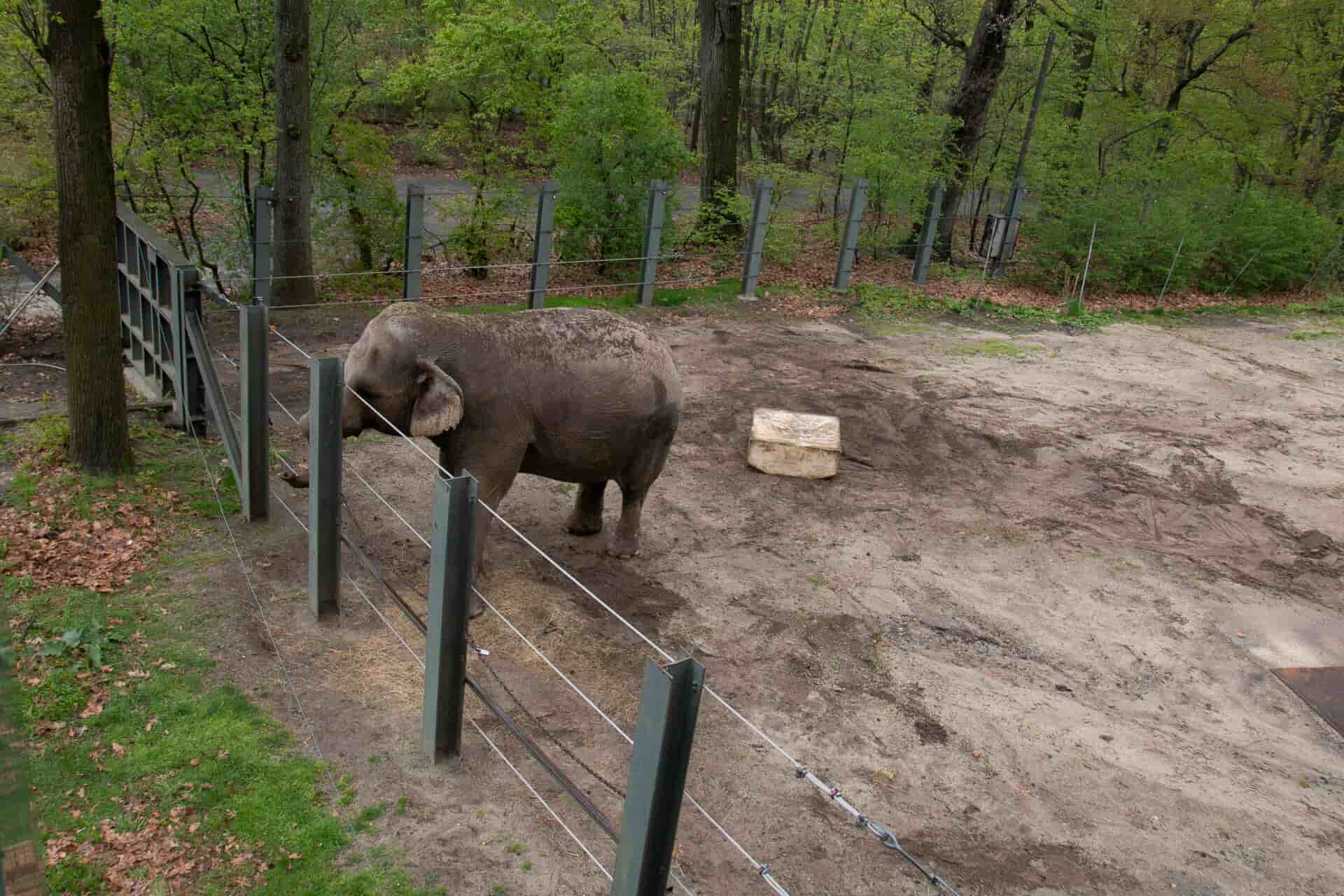
An Asian elephant named Happy who was the subject of a pioneering law suit and contributed to human understanding of animal self-awareness has died at the age of 55.
Happy had lived at New York’s Bronx Zoo since 1977, but recent veterinary evaluations suggested her kidneys and liver were declining and staff reluctantly took the decision to put her down.
Later, a necropsy, the animal version of an autopsy, revealed she had several large, inoperable uterine tumours, along with arthritis.
‘Making the decision to euthanise an animal is one of the hardest and most heartbreaking responsibilities in animal care, requiring immense compassion and love,’ said Craig Piper, interim director of the facility.
‘She died peacefully surrounded by the keepers, curators and veterinarians who have cared for her, some for more than 30 years. Their longstanding, deep relationships were invaluable to Happy throughout her life.
‘She was a wonderful elephant. She served as a tremendous ambassador for elephants and for elephant conservation.’
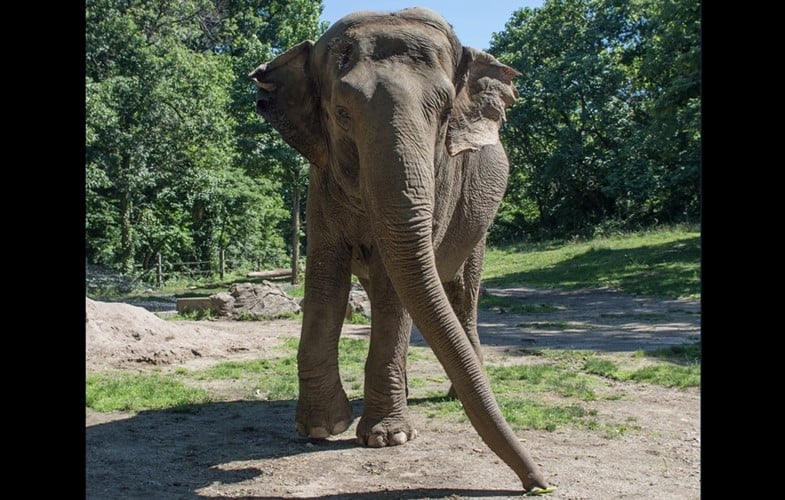
Experts believe the elephant was born in Thailand in 1971. She was brought to a Florida petting zoo before being acquired by the Bronx Zoo, which is operated by the Wildlife Conservation Society.
In 2006, researchers reported that Happy made scientific history by adding Asian elephants to the short list of animals to demonstrate signs of self-awareness, which, at the time, included only humans, apes and dolphins.
The study team had put a large mirror in the zoo’s elephant yard, and Happy, along with fellow pachyderms Maxine and Patty reacted to it in ways that suggested they didn’t think their mirror image was a separate animal individual.
But Happy took her interaction with her reflection one step further, using her trunk to touch a mark painted on her.
‘We put a visible white face paint mark on one side of her head, and an invisible face mark on the other side of her head. And the reason you do this is you want to make sure that the elephant isn’t touching the mark on its head just because it feels it or smells it,’ study co-author Joshua Plotnik, an animal behaviour researcher, told US reporters following the experiment.
‘And Happy, in front of the mirror, repeatedly touched the visible white X mark on her head more than 12 times.’
The behaviour suggested that Happy recognised that the image in the mirror was a reflection of herself, said the researchers.
Critics of Happy the Elephant’s Captivity
Throughout her lifetime, the practice of keeping elephants in zoo exhibits faced increasing scrutiny. Critics argued that urban animal parks were too confined for creatures that naturally traverse vast distances.
Also, animal rights activists contended that zoo enclosures were unsuitable for highly intelligent, social pachyderms.
This culminated in 2018, when the Nonhuman Rights Project (NhRP) took on Happy as a client, arguing that she should be granted habeas corpus, a fundamental US legal right that protects against illegal detention.
The group sued the Bronx Zoo to force them to release Happy to an elephant sanctuary, citing her exceptional intelligence.
Utilising a principle used to contest unlawful imprisonment, the activist group argued that Happy, an ‘extraordinarily cognitively complex and autonomous nonhuman being,’ was unjustly deprived of her liberty and suffered from isolation in her exhibit.
After a lengthy legal battle, the case ended in 2022, when a panel of judges on the New York Court of Appeals ruled in favour of the zoo by a five-to- two majority.
‘While no one disputes that elephants are intelligent beings deserving of proper care and compassion, habeas corpus is meant to protect the liberty of humans, not nonhuman animals like Happy’ ruled Janet DiFiore, Chief Justice.
One dissenter was Judge Rowan Wilson, who stated: ‘We should recognise Happy’s right to petition for her liberty not just because she is a wild animal who is not meant to be caged and displayed, but because the rights we confer on others define who we are as a society.’
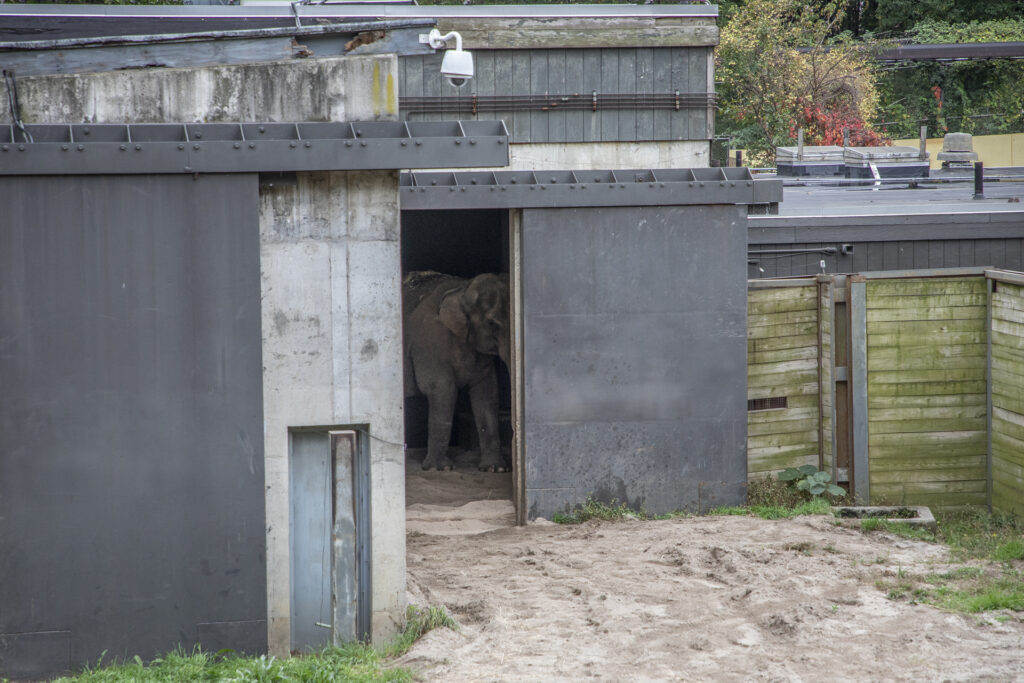
In her final weeks, Happy chose to spend her time in an off-exhibit barn and yard within her enclosure, according to Piper. In what the zoo described as a form of hospice care, staff provided hydration, nutrition, and pain management.
Following her death Christopher Berry, executive director of NhRP said: ‘Happy made history. She opened courtroom doors and brought attention to legal rights for animals.
However, while Happy’s legal case marked a significant milestone, her personal story is one of enduring hardship and loss. She suffered from the moment she was taken from her family and natural home in Thailand to the day she was euthanised inside a barn at the Bronx Zoo.
‘The Wildlife Conservation Society’s Bronx Zoo kept Happy in captivity in conditions that did not meet her complex needs since 1977, and in solitary confinement for 20 years. As a result, she suffered significant physical and psychological harm.
‘Happy’s suffering will not be in vain. Happy will always be remembered as the elephant who opened the courtroom doors for legal rights for animals, who may be entitled to liberty.
‘Happy also inspired the passage of the first animal rights legislation in the US and the introduction of the first elephant captivity ban in New York City.
‘The story of the injustice of her life will continue to be told. It will continue to touch the hearts of people around the world, including judges and elected officials with the courage to recognise that animals like Happy have legal rights and that there is no justification for taking away their freedom.’
Berry then called for the only elephant now housed at the zoo to be released, stating: ‘The Bronx Zoo and the Wildlife Conservation Society failed Happy. But they can still choose to do the right thing for the one remaining elephant at the Bronx Zoo, Patty.’