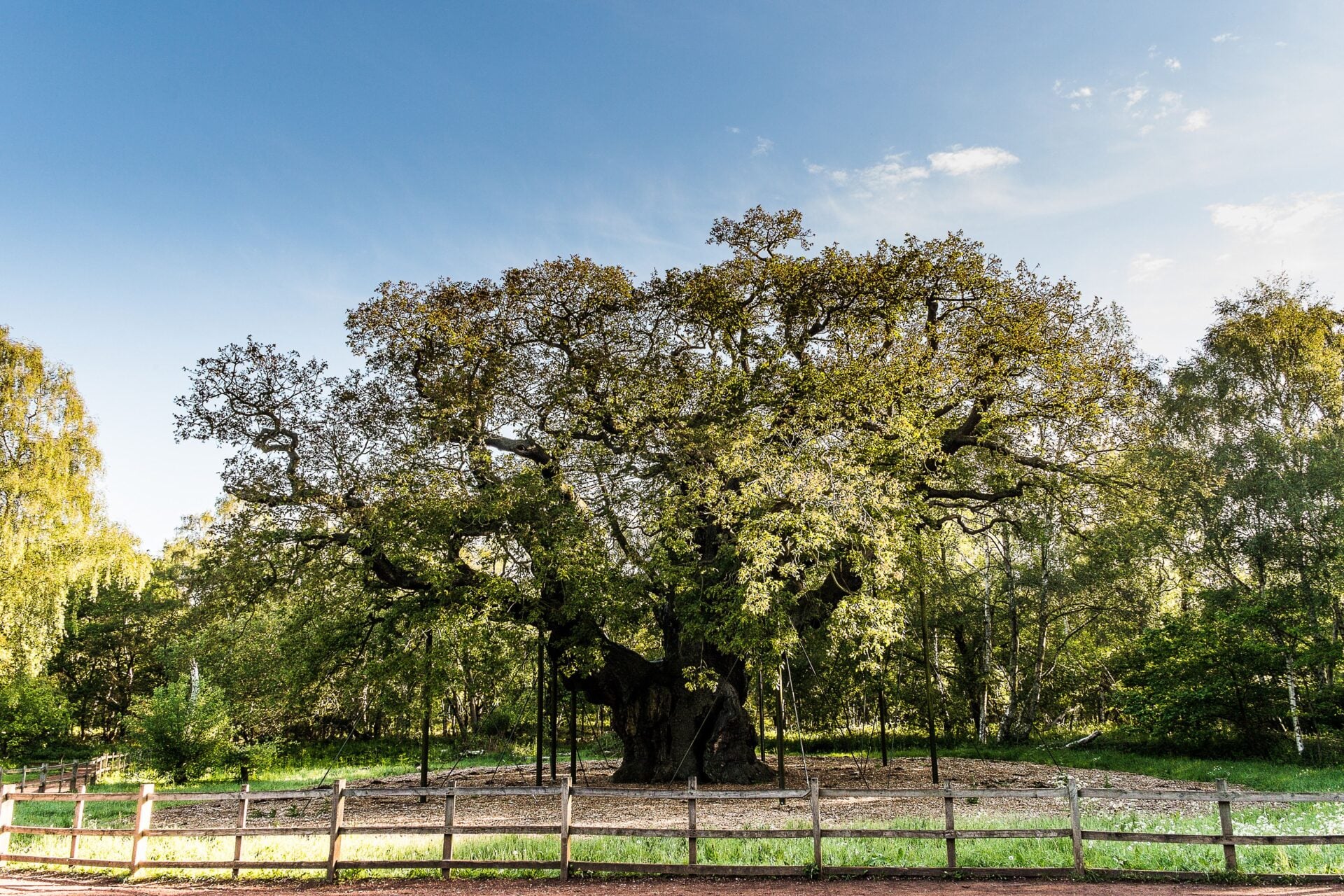
A thousand-year-old tree, featured in the legends of the English outlaw Robin Hood, has become a victim of the climate crisis.
The Major Oak, known as the Robin Hood Tree and one of Europe’s oldest, largest, and most famous ancient trees, died after failing to produce any leaves this year due to a series of hot, dry summers.
The huge tree, in Sherwood Forest, celebrated for hundreds of years as the home of Robin and his ‘Merry Men’ boasts an 11-metre girth and 28-metre canopy
It was said to have provided a sanctuary for the outlaw and his gang when fleeing the tyrannical Sheriff of Nottingham.
In 1904, props and metal chains were installed to support its branches, and in the 1960s, hollow parts were filled with concrete to support it, while limbs were reinforced with lead, then fibre-glass and treated with fire-retardant paint
Robert Brackley, an educator who has shown thousands of schoolchildren the tree, while dressed in a Robin Hood costume with trademark bow and arrow, said: ‘The stories it has given us is the legacy.
‘It’s the most famous tree in the world. The legend always lives on. I feel sad but it’s a fleeting moment in time. We must remember how it was and be in awe of it today.’
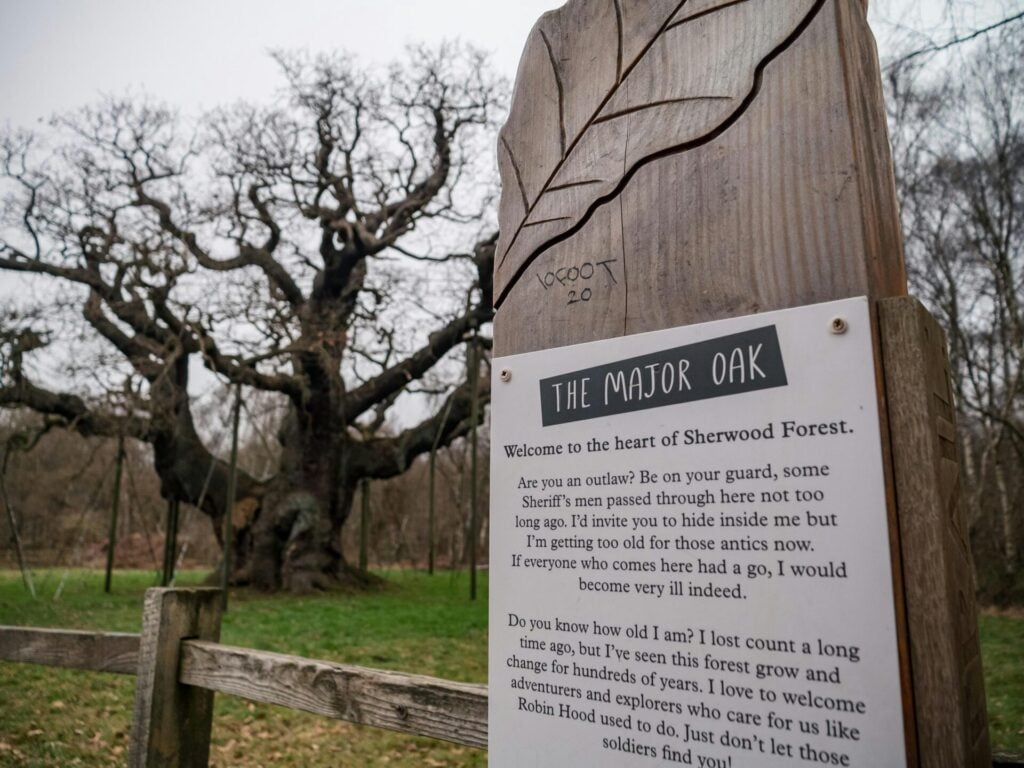
The death of the Robin Hood Tree may have also been hastened by attempts to preserve it.
Did preserving the Robin Hood Tree hasten it’s demise?
In 1904, props and metal chains were installed to support its branches, and in the 1960s, hollow parts were filled with concrete to support it, while limbs were reinforced with lead, then fibre-glass and treated with fire-retardant paint.
But now experts believe that the props designed to support the tree also placed it under much greater strain, especially as more water was needed for its branches at times when resources were becoming scarcer, due to hot weather.
Left alone, ancient oaks shed their outer limbs and become smaller requiring less water and nutrients as they age.
The props ‘probably impacted its ability to sustain itself,’ said Chloe Ryder, Sherwood Forest estates operations manager for the Royal Society for the Protection of Birds (RSPB), but they could not be removed because the tree would have collapsed.
She said: ‘It’s heartbreaking. I’m genuinely gutted it’s happened in my lifetime, let alone in my tenure. I’ve almost dreaded coming to see it and have that confirmation, and see no leaves on it. I still think it’s one of the most beautiful trees. We call it a living museum because it’s got so much to teach us, both good and bad.’
The Major Oak, which in recent years attracted more than 300,000 visitors annually, first acquired its name after being featured in a book by botanist Major Hayman Rooke in 1790.
The Robin Hood Tree was so famous that acorns and cuttings have been grown from it, and saplings from the oak have been planted around the world.
England is currently home to 114 living ancient oaks with a diameter of more than nine metres, with only 98 found across the rest of Europe, including Scotland and Wales.
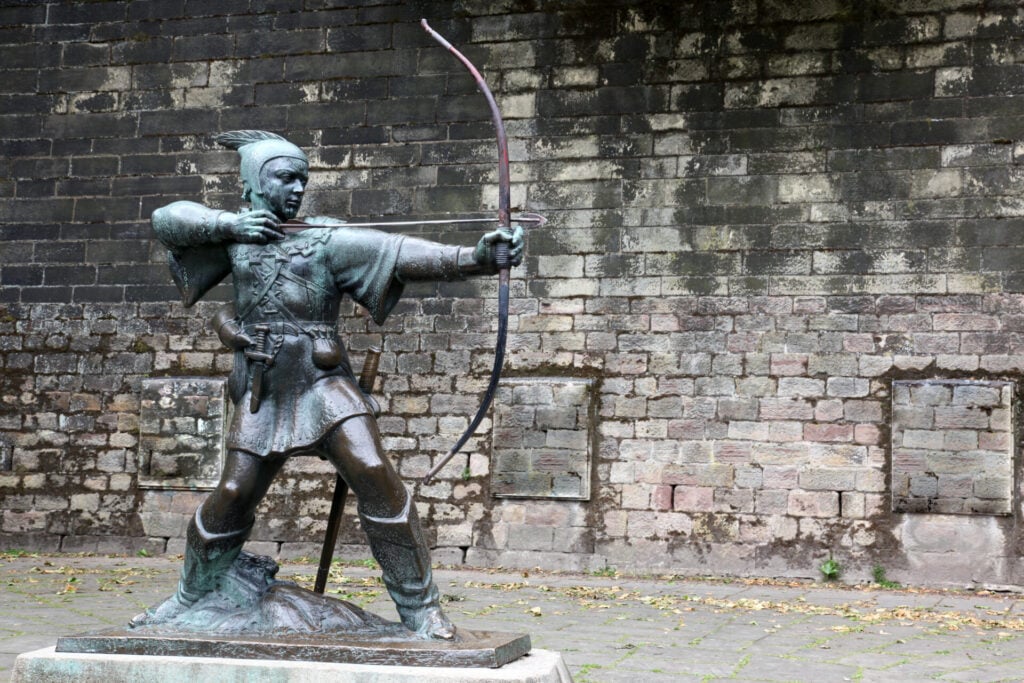
Robin Hood, first mentioned in ballads from medieval England, is usually portrayed as an outlaw of Saxon origin who, together with his band including Little John, Friar Tuck and Will Scarlett, robbed wealthy Norman lords and gave their money and jewels to poor people.
The character has been played on screen by stars such as Russell Crowe and Errol Flynn, with Hugh Jackman the latest to don the cloak and take up the longbow in ‘The Death of Robin Hood’.