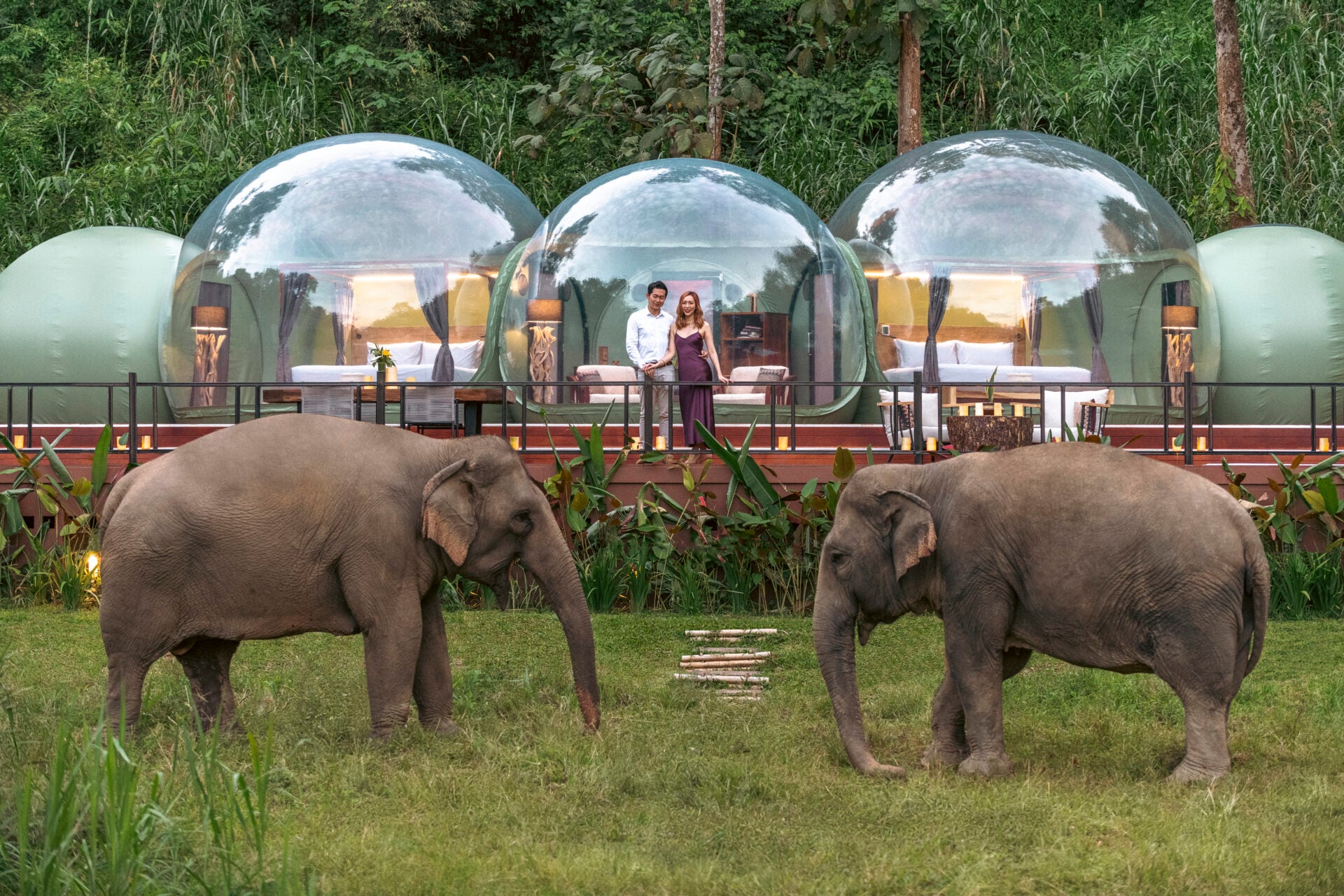
Standing under the dome of my transparent Jungle Bubble tent, I watch rain droplets wind their way down the curved sides, blurring the view as the sky shifts from red to purple and finally to midnight blue. Despite the light shower, I step out onto the elevated deck where a few stubborn stars pierce through the clouds. Fireflies pulse in the darkness but it’s the sound of tearing grass and the shuffle of giant feet that hold my attention. Just metres away, two elephants graze quietly in the dark, illuminated by the soft light filtering from tonight’s accommodation.
This is no ordinary stay. I’m at Anantara Golden Triangle Elephant Camp & Resort, tucked into the forested hills of northern Thailand, a stone’s throw from Laos and Myanmar. It’s home to the Golden Triangle Asian Elephant Foundation (GTAEF), which rescues elephants from exploitative tourism and gives them a safe, semi-wild place to live out their days in dignity. It’s also one of the most sustainable luxury resorts in Asia.
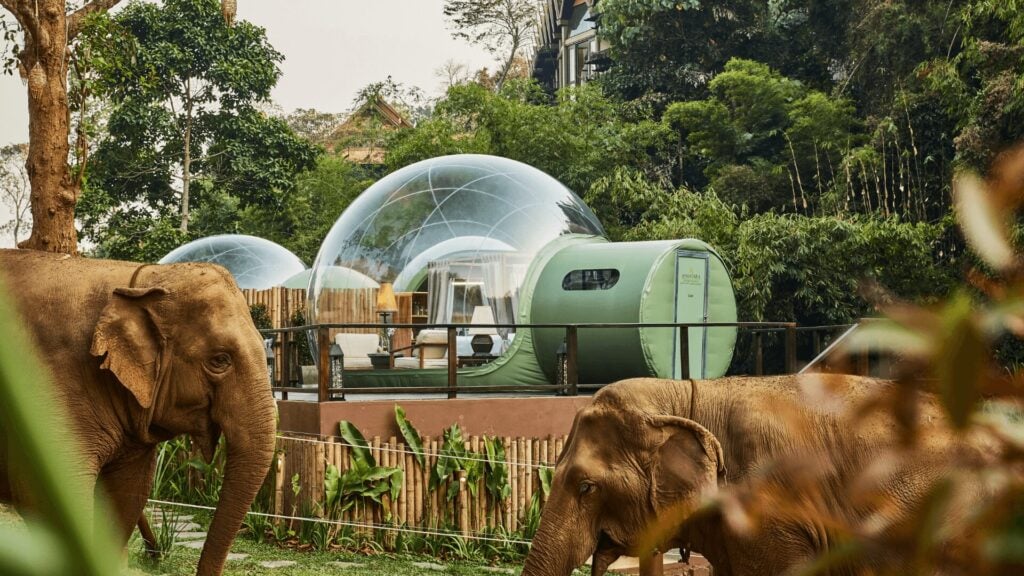
The Jungle Bubble speaks volumes to this. With polished wood floors, air conditioning, a hotel standard double bed, and a ‘real’ bathroom, you’d be forgiven for forgetting you’re techinically camping. A butler delivers dinner and drinks to the deck before nightfall, and I drift off later to the sound of elephants – who only sleep for a few hours a night – foraging outside.
With polished wood floors, air conditioning, a hotel standard double bed, and a ‘real’ bathroom, you’d be forgiven for forgetting you’re techinically camping. A butler delivers dinner and drinks to the deck before nightfall, and I drift off later to the sound of elephants
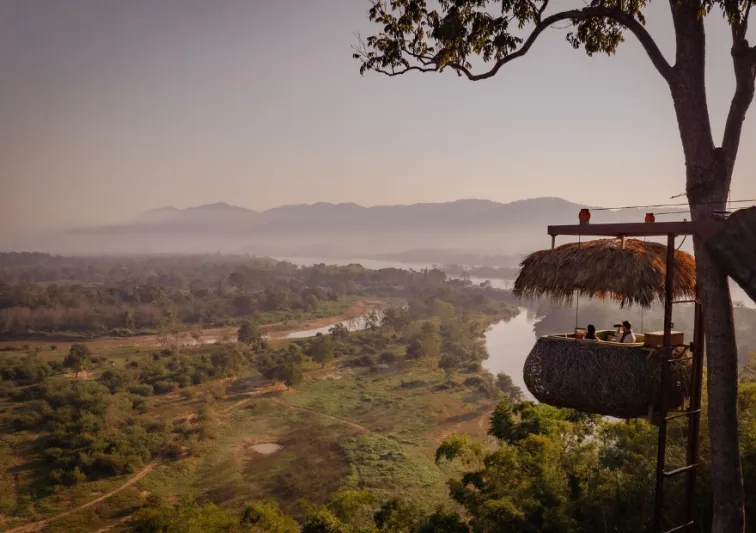
The next morning I skip the snooze button and make my way to breakfast at Canopy, the resort’s bamboo capsule dining experience perched 52 metres above the grasslands with 360-degree views of the Golden Triangle. From this treetop perch, I sip strong Thai coffee and watch some of the resort’s 20 resident elephants wander through the 160 acres of protected jungle.
Breakfast is a chilli and mushroom omelette kept warm in nature-inspired Thai tiffin containers, followed by fresh bread and pastries drizzled with honey and homemade jams. They’re ingredients I later discover were harvested from the resort’s organic garden, mushroom farm, and one of ten working beehives. Sustainability isn’t a sideshow here either, it was recently certified Green Growth 2050 Gold, one of the strictest eco standards in hospitality.
Walking With Giants
That ethos carries through to the resort’s most unforgettable activity: Walking with Giants, where you can join elephants on their daily walk and watch as they splash in the river, take a mud bath and socialise with one another. Unlike many elephant tourism destinations, forced interactions such as riding and bathing aren’t allowed here. Instead, guests are invited to walk alongside these 4,000 kg giants – they are the largest living land animals – as they go about their day in peace, picnic on the grounds with elephants in the vicinity, or even learn how to make medicinal food for the elderly members of the herd.
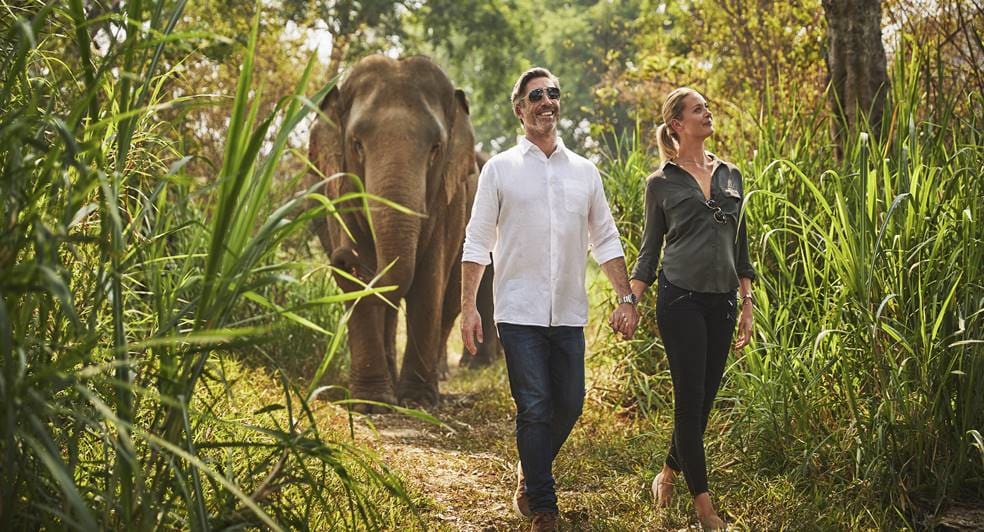
I spend the remainder of the morning with Tao, a denim dungaree-clad mahout – handlers who have often been by their elephant’s sides for decades – who has worked with wildlife for 19 years. We follow a female and a calf through the undergrowth, watching them stop to scratch, snack, and cuddle with their trunks. Occasionally, they pause and let out slow sounding whines to one another. ‘That’s them talking,’ Tao tells me. ‘They do it all the time.’
I knew elephants could send rumbling soundwaves through the ground to one aother but I’d never realised they chatter together like gossiping grandmas. For such emotionally intelligent creatures, I probably shouldn’t have been surprised.
Most of the 20 elephants now roaming the property were rescued from logging camps, street begging or circuses, and many arrived with physical and emotional injuries.
While the pair talking beside us are not biologically related, they have a close bond, and it turns out many of the elephants have found best friends. Kamoom, rescued from the tourism circuit during Covid, rarely leaves the side of Jatol, who used to carry tourists on her back in searing heat on concrete streets. Most of the 20 elephants now roaming the propert were rescued from logging camps, street begging or circuses, and many arrived with physical and emotional injuries. But thanks to the care of GTAEF, the resort, and the companionship of one another, they are healing.
I learn that the foundation never buys elephants in order to prevent fuelling the industry it’s trying to dismantle. Instead, they are all rescued, and along with their mahouts – and their families – are brought to Anantara Golden Triangle Elephant Camp & Resort. The mahouts are given housing on-site, education for their children, and ethical employment, ensuring both humans and animals thrive.
Roots to Rooftops
After lunch, I join a tour of the chef’s sustainable garden, an area brimming with the likes of chillies, papaya, and eggplants. There’s a mushroom shed producing a staggering 3,000 kg of oyster mushrooms a year, and chickens laying up to 80 eggs a day. Everything grown or produced here makes its way into guest meals or sustainable cocktails. What the guests don’t eat, the elephants do. And what the elephants don’t eat gets composted by an on-site biodigester – a system that breaks down organic waste into natural gas – that powers the staff quarters.
Outside, a private plunge pool allows guests to swim right up to the edge and gaze into the jungle beyond. On the terrace, a bathtub with clawed feet is surrounded by nothing but rainforest. I’m only here for one night but I could happily stay far longer.
By late afternoon, I’m back and barefoot at the infinity pool, sipping a homemade lemongrass infusion through a durum wheat straw, no less, while butterflies flit by and I take in the stunning views. Then it’s time to pack up for a new experience: the Explorer Tented Camp, reached by a tandem Sky Bike that can be ridden like a bicycle or operated electrically across a 300 metre-long zipline. Suspended 40 metres in the air, it offers stunning jungle views across the three countries converging at the Mekong River.
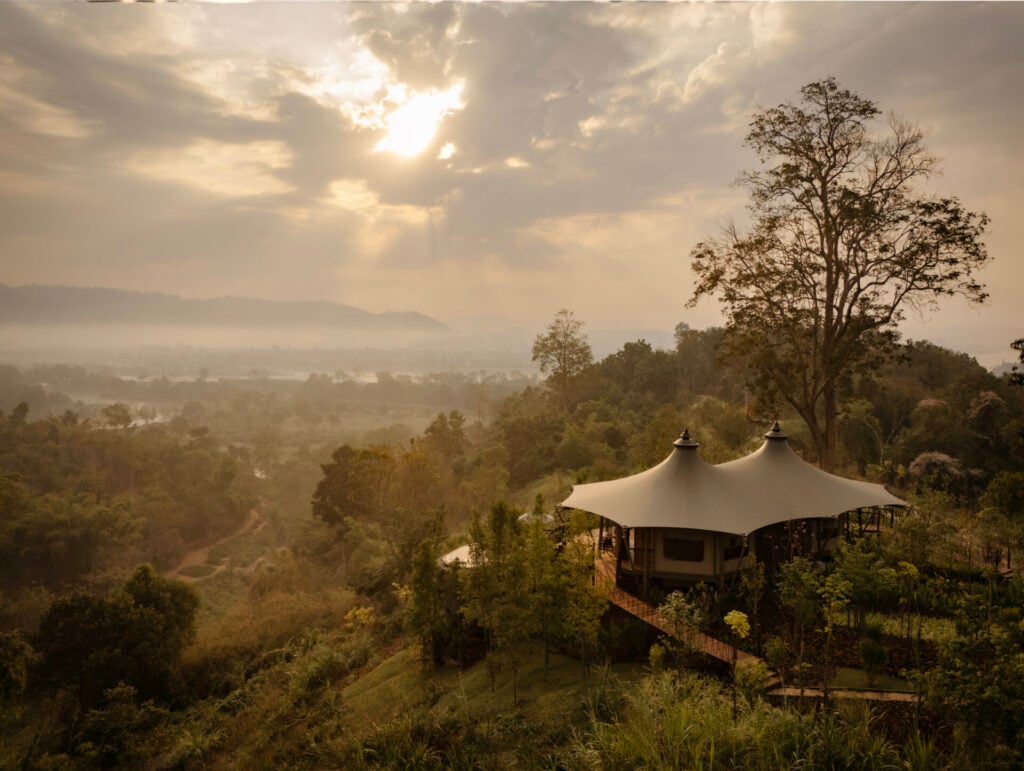
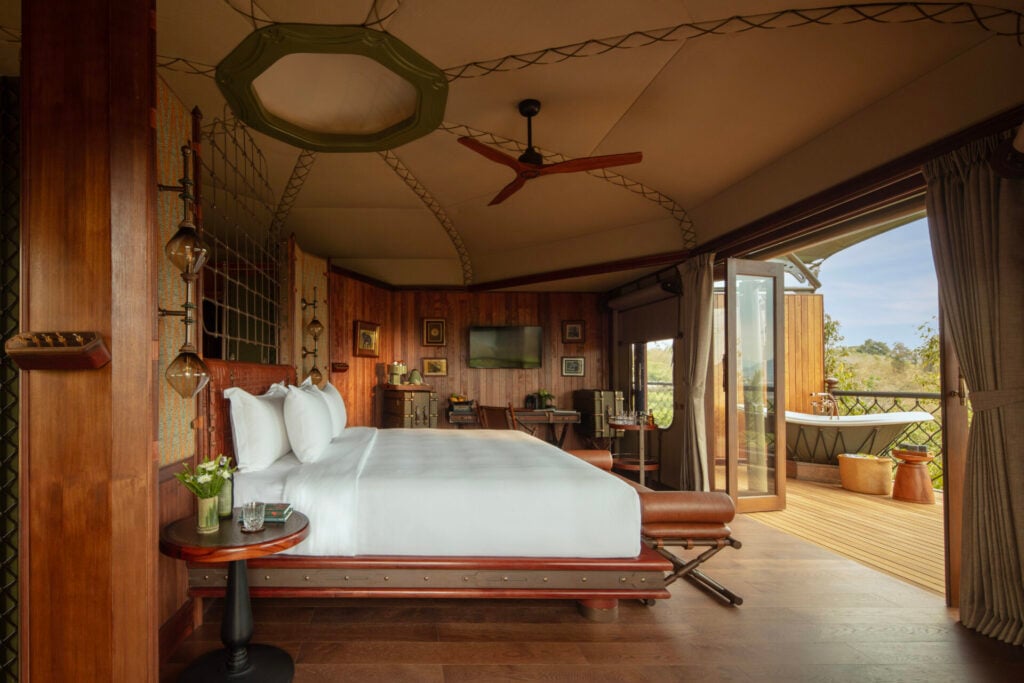
Almost brand new and styled like a luxurious safari retreat, my tented suite is all Thai timber, handwoven textiles and solar-heated touches. There’s no single-use plastic in sight, and everything feels designed to tread lightly on the land. A welcome tray is thoughtfully stocked with locally sourced teas from Sawanbondin, handcrafted chocolates from Kad Kokoa, and crisp mushroom snacks made in collaboration with DoiTung– a social enterprise supporting local livelihoods in Northern Thailand. The elephant-shaped butter cookies are a nod to the pachyderm neighbours, and the Praewa cloth bag, once used by Lanna hill tribes, is a cultural and practical companion for your stay.
Outside, a private plunge pool allows guests to swim right up to the edge and gaze into the jungle beyond. On the terrace, a bathtub with clawed feet is surrounded by nothing but rainforest. I’m only here for one night but I could happily stay far longer.
On my final night back at the resort, I stop in at the Elephant Bar & Opium Terrace, where the dark teak interiors, whirring ceiling fans, and faux-animal-hide lamps conjure colonial-era adventure. There’s even an open fire for when temperatures drop. I order a fiery, fragrant blend of chilli, galangal, kaffir lime leaf and spirits, concocted by head mixologist Atip using ingredients from the garden I toured earlier. The drink, I realise, is much like the resort: luxurious, local, and leaves no trace.
GETTING THERE
From the UAE, the easiest route to Anantara Golden Triangle Elephant Camp & Resort is via Bangkok.
Emirates operates direct flights from Dubai to Bangkok in around six to seven hours, followed by a short domestic flight to Chiang Rai, which takes approximately 1 hour and 20 minutes.
From Chiang Rai International Airport, the resort is around a one-hour private transfer through northern Thailand’s lush countryside, with airport transfers available through the hotel.
For more information and current rates visit: anantara.com/golden-triangle-chiang-rai