

A bizarre plan backed by former UK Prime Minister Margaret Thatcher to wipe out South America’s cocaine crops by unleashing swarms of leaf-eating moths over drug cartel plantations has been revealed in newly released government papers.
The scheme, developed in 1989, would have seen thousands of insects bred by scientists at the bio-chemical warfare research establishment at Porton Down dropped from military helicopters over coca fields in Peru, a country which had requested British aid in its anti-drug production campaign.
Government papers, released by the National Archives at Kew, show Thatcher’s Conservative administration spent around $120,000 exploring the idea in a bid to curb the flow of the Class A drug.
At the centre of the plan was Eloria noyesi, a species of moth whose larvae feed almost exclusively on coca leaves, the raw ingredient used to produce cocaine.
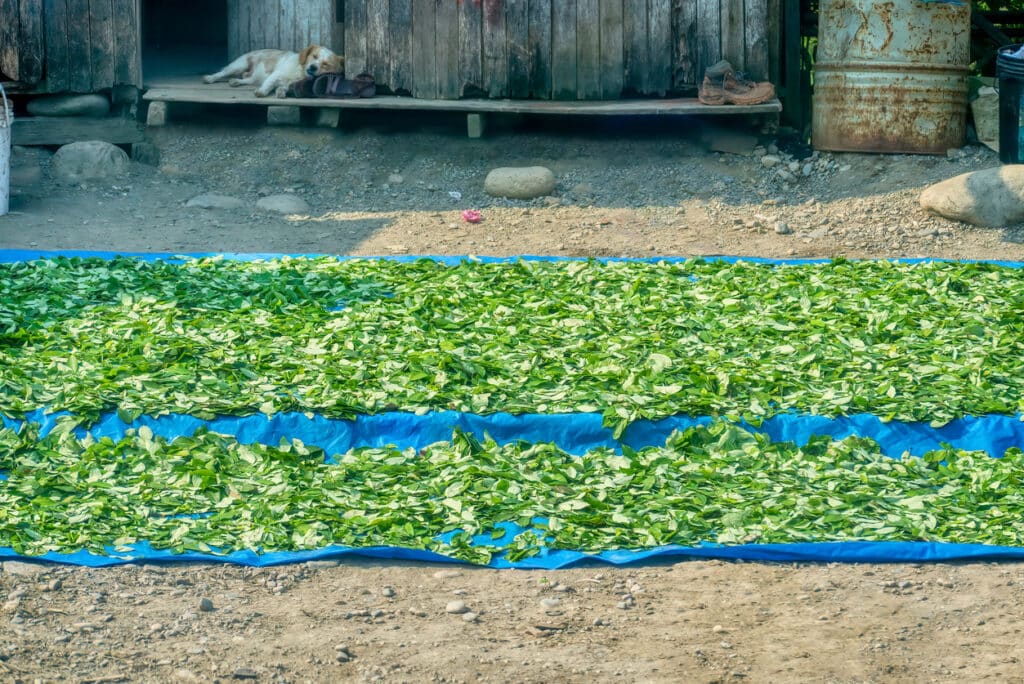
Unlike most insects, the moth can consume coca leaves safely and process the chemicals without suffering any ill effects.
Officials believed the insect could provide a biological weapon against powerful drug trafficking organisations operating across South America.
‘It is clear that this moth offers great potential for the biological control of illegal crops, provided a way can be found to propagate the insects in very large numbers,’ the newly-released report said.
Officials noted that ‘unprecedented swarms’ of the moth had destroyed around 2,000 hectares of illegal coca cultivation, causing estimated losses of more than $37 million for traffickers
‘Inundation is likely to cause significant, but localised, damage to coca plantations and reduce yields. The method is relatively cheap and simple.’
Documents show military scientists were tasked with investigating ways to breed the moths in huge numbers.
Sir Robin Butler, then cabinet secretary, discussed the plans with senior officials on November 16th, 1989, before reporting to Thatcher.

‘The Prime Minister had said that the idea was sufficiently interesting to merit being pursued,’ a Cabinet Office briefing note contained in the papers said.
According to Foreign Office notes, the proposal was inspired by a naturally occurring infestation that devastated coca crops near the Peruvian city of Tarapoto between 1987 and 1988.
Officials noted that ‘unprecedented swarms’ of the moth had destroyed around 2,000 hectares of illegal coca cultivation, causing estimated losses of more than $37 million for traffickers.
The files show Thatcher personally supported further investigation of the project and considered the idea ‘sufficiently interesting to merit being pursued’.
However, concerns soon emerged over its effectiveness and the possible environmental consequences and the UK Home Office concluded that while the scheme appeared technically feasible, any impact on cocaine production would only be temporary.
By the end of 1989, ministers feared that any leak could jeopardise the operation, support from the Peruvian authorities was waning, and logistical problems on how to get the insects across the Atlantic meant the weaponised moths programme never progressed.