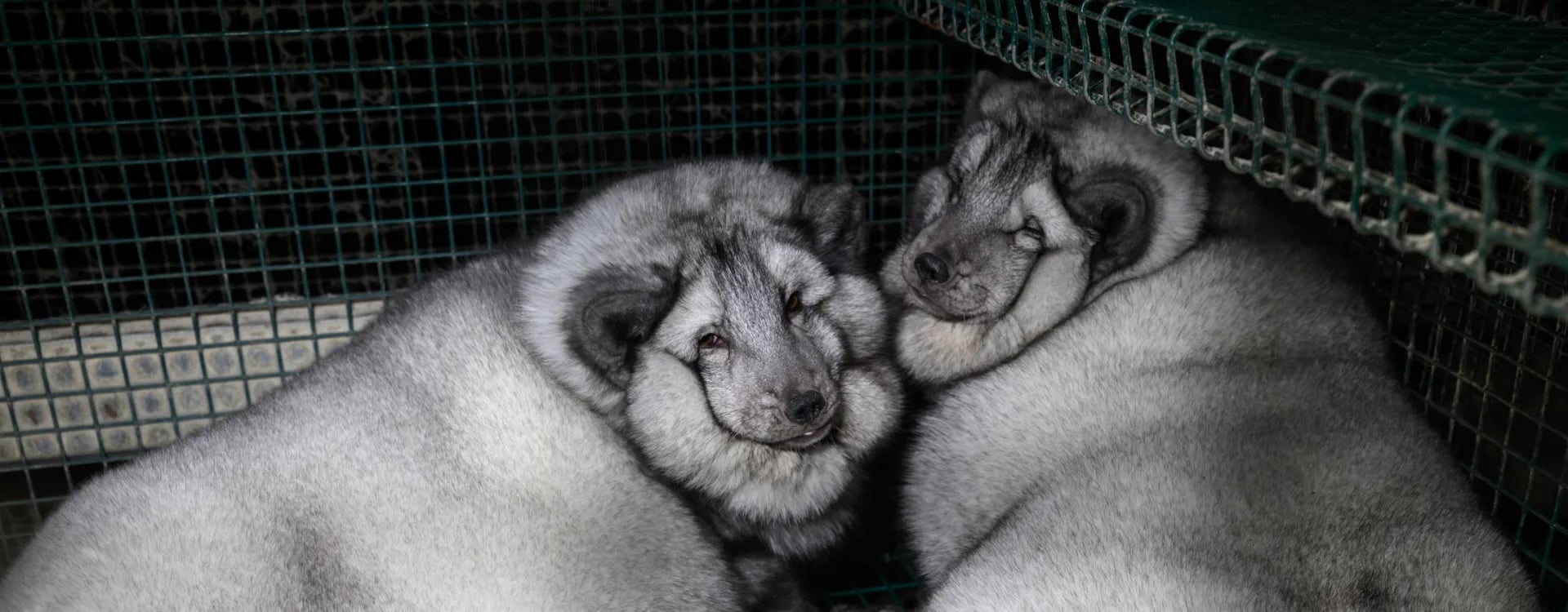
Footage from Finnish fur farms shows foxes with extreme skin folds, eye infections and impaired mobility, suggesting that oversized breeding continues despite a 2017 industry pledge to stop it.

Footage recorded on fox farms in Lapua, Veteli and Kauhava, Finland, between November 2025 and April 2026 shows animals so overweight their skin sags in heavy folds, some with severe, untreated eye infections and injuries, struggling to move inside cramped wire-mesh cages.
It was released on 3 September 2026 by member organisations GAIA and Project 1882, together with the Fur Free Alliance, an international coalition of animal protection organisations. Project 1882 says the material was provided by an anonymous source.
These foxes are literally being deformed to produce a few extra centimetres of fur. This is how far this industry is prepared to go to increase its profits. Europe must stop looking for ways to better regulate this cruelty: it must put an end to it.
Sébastien de Jonge, Director of Operations, GAIA.
Oversized fox breeding first drew widespread attention in 2017, when images showed blue foxes selectively bred to reach abnormally large sizes for bigger, higher-value pelts.
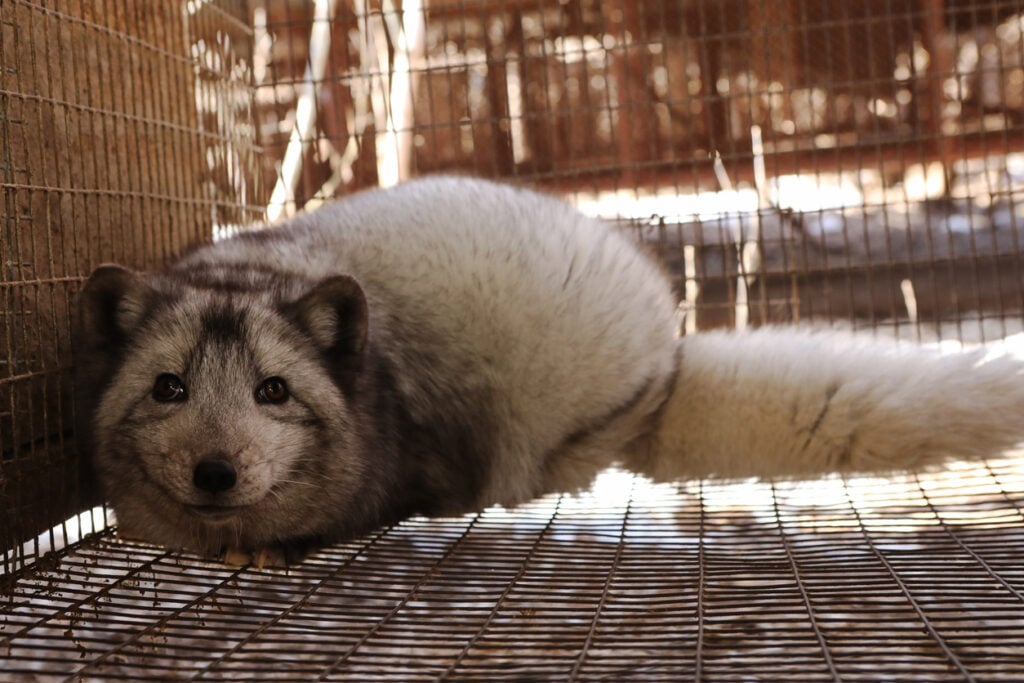
Finnish fur farmers’ association Fifur (then known as Profur) responded with a pledge: a maximum pelt length of around 155–160cm, and a body condition index monitoring system across the industry. Nine years on, that promise appears not to have held.
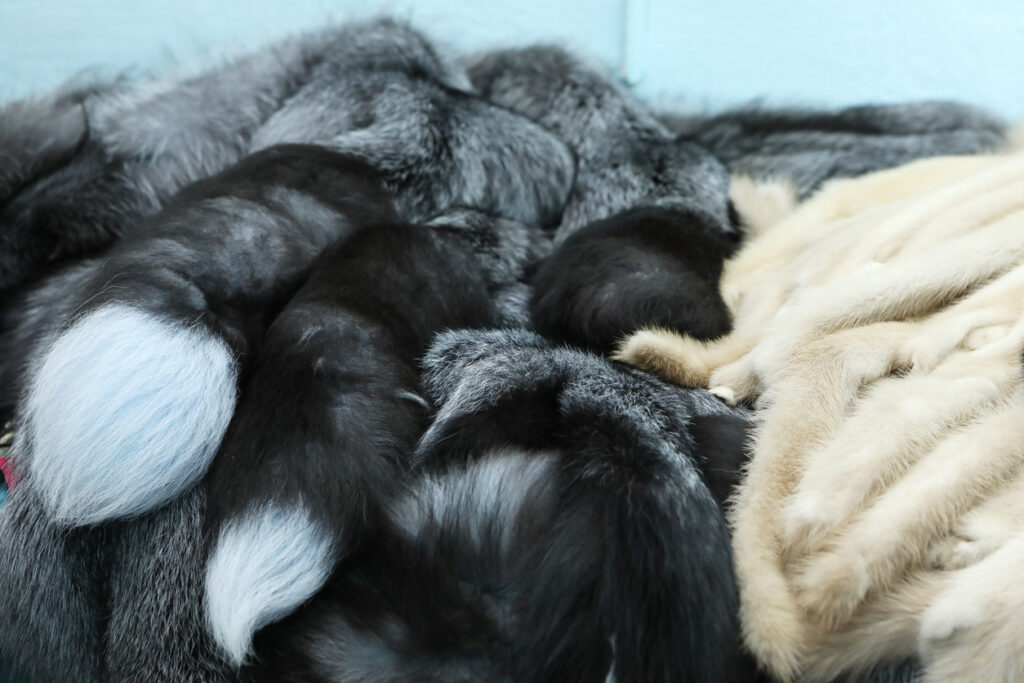
In 2026, Finnish auction house Saga Furs introduced a new, larger pelt category. At its March sale, more than 12,000 size 70 blue fox pelts were sold, exceeding the maximum size of 60 the industry had previously set.
The issue goes back further still. The member organisation of the Eurogroup for Animals, Animalia, first raised the alarm over oversized foxes in Finland in 1989, when a fox from a Finnish fur farm was found to be in so much pain that veterinarians recommended euthanasia.
The case led Finland’s Ministry of Agriculture and Forestry to ban the breeding of oversized foxes at the time.
Science backs this up: in a 2025 scientific opinion, the European Food Safety Authority (EFSA) found that most welfare consequences of fur farming cannot be prevented or sufficiently mitigated through corrective measures.
Arctic (blue) foxes bred for their fur weighed around 7–8kg in the 1990s; by 2014, that had risen to around 20kg, more than double the weight of a wild Arctic fox. EFSA named leg deformities and other locomotor disorders among the most significant welfare consequences of this selective breeding.
Project 1882
The footage comes as the European Commission prepares its final decision on Fur Free Europe, the European Citizens’ Initiative Eurogroup for Animals and its members launched in 2022.
Signature collection closed in 2023 with more than 1.5 million validated signatures, the most successful European Citizens’ Initiative for animals to date. The European Commission’s decision was initially expected in March 2026 and has since been delayed.
No animal should be confined to a cage and killed for its fur. The images from Finland make it unmistakably clear that the fur industry is built on suffering that cannot be justified. This is why fur farming must be banned, both in Sweden and throughout the European Union.
Benny Andersson, CEO, Project 1882.
A government inquiry in Sweden has also proposed a national ban on breeding and keeping animals for fur production.
Banning fur farming makes more economic sense
Meanwhile, a new report launched this week suggests a five-year phase-out for all fur farms in the EU would cost significantly less than subsidising new welfare standards that will still fail to meet the needs of wild animals raised for fur.
The report estimates that phasing out the EU’s remaining fur farms would cost approximately €144 million, whereas implementing new welfare standards could cost anywhere between €201 million and €920 million, depending on the measures introduced, for a transition time of five years.
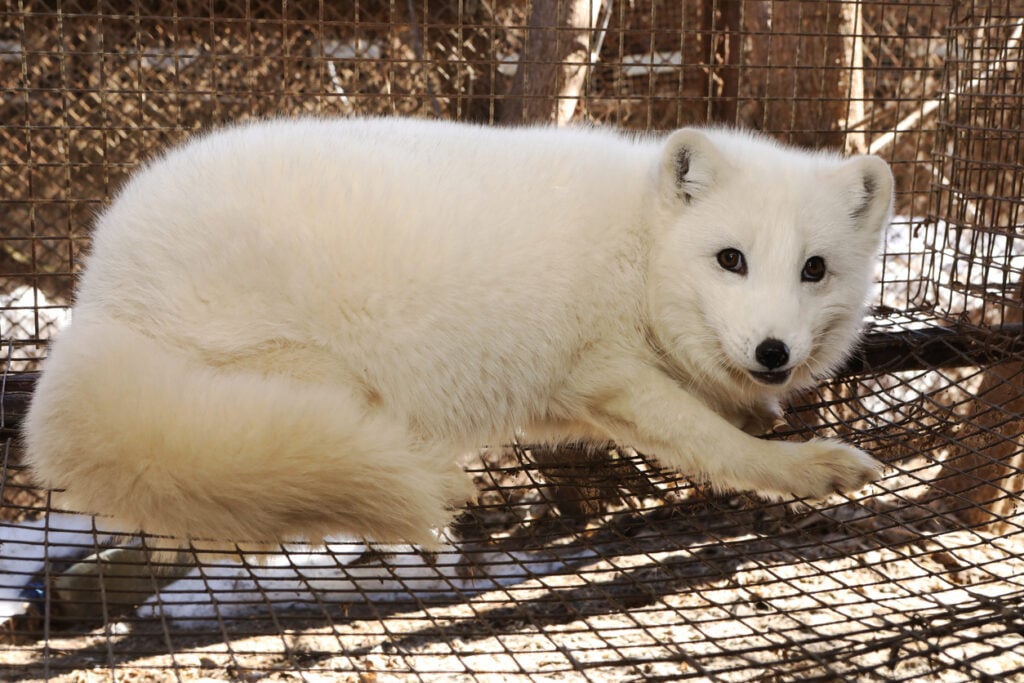
The findings come as the European Commission (EC) considers its response to the Fur Free Europe ECI, in which more than 1.5 million EU citizens called for a ban on fur farming and the placing of farmed fur products on the EU market.
‘The EU faces a straightforward choice: invest once in a fair transition away from fur farming, or spend far more trying to sustain an ever-declining industry that can never provide animals with a dignified life, for an out-of-fashion product’
Nick Clark, Wild Animals Senior Programme Leader at Eurogroup for Animals
‘The EU faces a straightforward choice: invest once in a fair transition away from fur farming, or spend far more trying to sustain an ever-declining industry that can never provide animals with a dignified life, for an out-of-fashion product’ says Nick Clark, Wild Animals Senior Programme Leader at Eurogroup for Animals.
‘Using public money to modify cages is not a lasting solution, while it locks in wild animals in an industry that can never meet their welfare needs. The European Commission should listen to citizens, follow the economic and scientific evidence and bring fur farming to an end.’
The report highlights that a phase-out is a one-off transition cost, rather than the costs of maintaining fur production under new standards. If the EU chooses to introduce new standards, public money would be required not only to support their implementation, but also to sustain an industry that already imposes significant wider costs.
Previous research estimates that fur farming imposes wider costs on society of roughly €446 million annually in harms from pollution, resource use, local disamenity, and invasive alien species.
With the Commission’s decision still pending, you can message the College of Commissioners, calling for the ban that 1.5 million citizens asked for.